

Table of contents
- 🤖 1. Siri AI — The Complete Rebuild of Apple’s Digital Assistant
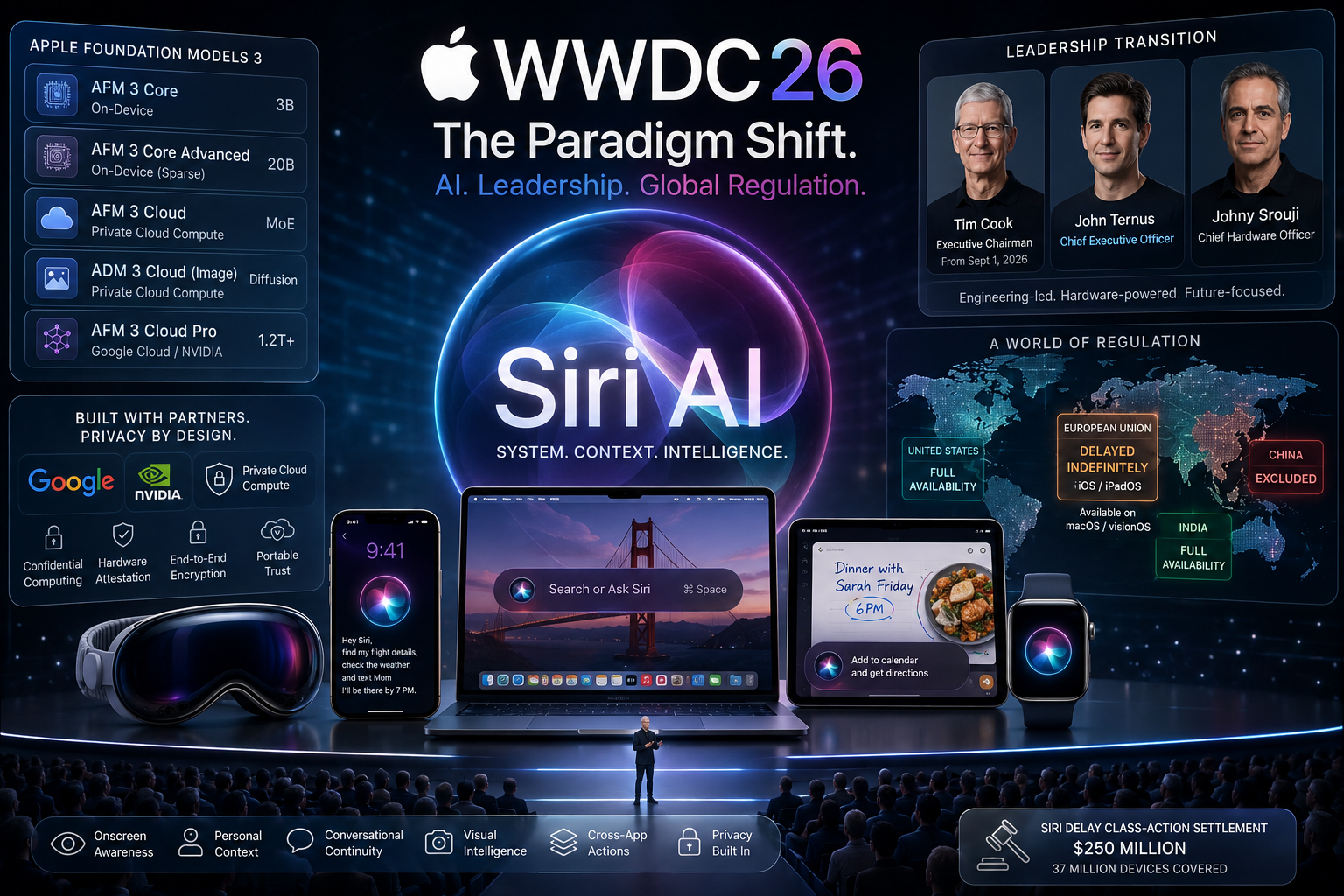
- 🧠 2. Apple Foundation Models 3 (AFM 3) — Technical Deep Dive
- 🤝 3. Google Gemini × Apple: The $1 Billion AI Partnership Explained
- 🌍 4. The Regulatory War: EU DMA Block, China Exclusion & India Antitrust Battle
- ⚖️ 5. The $250 Million Siri Class-Action Settlement
- 👔 6. Leadership Shakeup: Tim Cook Out, John Ternus In as Apple CEO
- 📱 7. Hardware Roadmap Hints Hidden Inside iOS 27
- 🔧 8. iOS 27 & macOS Golden Gate — Beyond the AI Headlines
- ❓ Frequently Asked Questions About Apple WWDC 2026 Siri AI
- 🏁 Final Verdict: Apple WWDC 2026 Siri AI Is the Inflection Point
🚨 BREAKING HIGHLIGHTS ✅ Siri AI officially replaces the legacy Siri — a ground-up rebuild powered by Apple Foundation Models 3 (AFM 3) ✅ Apple signs a ~$1 billion/year licensing deal with Google’s Gemini models for frontier AI ✅ Tim Cook steps down as CEO; hardware engineer John Ternus takes charge effective September 1, 2026 ✅ Siri AI on iOS 27 blocked in the EU indefinitely due to Digital Markets Act conflicts ✅ Apple settles a $250 million class-action lawsuit over delayed Apple Intelligence features ✅ iOS 27, macOS 27 Golden Gate, homeOS, and the rumoured foldable iPhone are now official
Apple’s Worldwide Developers Conference (WWDC) 2026 has officially gone down as the most consequential developer conference in the company’s recent history. After two years of withering criticism over its artificial intelligence roadmap, Apple arrived at Cupertino’s Steve Jobs Theater on June 9, 2026, with a sweeping response that reframes every pillar of its software strategy — from the Apple Intelligence platform to executive leadership, regulatory policy, and hardware design.
This comprehensive breakdown covers every major announcement from Apple WWDC 2026, analysed through the lens of SEO, technology journalism, and market strategy. Whether you’re a developer, an Apple enthusiast, or a tech investor, this guide explains exactly what the Siri AI revolution means for you, your devices, and the broader AI landscape in 2026.
🤖 1. Siri AI — The Complete Rebuild of Apple’s Digital Assistant
The original Siri, launched in 2011, was built on a stateless, command-response model — it heard your request, executed it, and forgot everything. Apple WWDC 2026 Siri AI dismantles that architecture entirely.
Siri AI — the new name for Apple’s completely reimagined virtual assistant — functions as a persistent system orchestrator embedded directly into the iOS 27 and macOS 27 Golden Gate operating system substrate. It doesn’t just answer questions. It reasons, plans, remembers, and acts across your entire Apple ecosystem.
🔍 What Makes Siri AI Different from the Old Siri?
The new Apple AI assistant 2026 introduces three revolutionary capabilities that define the Siri AI era:
1. 🧩 Personal Semantic Index Access Siri AI can traverse all your data silos — messages, emails, photos, calendar events, and third-party apps integrated through Spotlight — to retrieve hyper-specific, personalised information. Ask it to find a hotel booking confirmation buried in a six-month-old email chain and it will surface the exact confirmation number in seconds.
2. 👁️ Onscreen Awareness & Multimodal Visual Intelligence The Apple on-device AI can optically interpret whatever is actively displayed on your screen. Point your iPhone camera at a restaurant bill and ask Siri to split it among contacts via Apple Cash. On iPadOS 27, circle elements with an Apple Pencil to trigger visual queries. On macOS Golden Gate, a dedicated keyboard shortcut transforms Siri into a desktop research co-pilot. On visionOS 27, simply gaze at a physical object in your space and ask.
3. 💬 Conversational Continuity with a Dedicated App In a historic reversal, Apple has launched a standalone Siri AI app — essentially a chatbot-style interface that stores and syncs your entire conversation history through end-to-end encrypted iCloud. Start a query on your Mac; finish it on your iPhone. This is Apple’s direct answer to ChatGPT and Google Gemini.
💡 Pro Insight: The new Siri invocation UI no longer covers your screen with a solid overlay. Instead, a glowing animation emanates from the Dynamic Island — a visual language that communicates Siri’s deep integration with iOS 27 itself.
🎙️ Voice, Tone & Expressiveness
The Apple Intelligence iOS 27 update brings a completely rebuilt text-to-speech engine. Users can now adjust the pace, tone, and expressiveness of Siri’s voice output, achieving a Mean Opinion Score (MOS) of 4.24 out of 5.0 in internal evaluations — a major leap from the previous 3.82 score. This places Apple’s AI voice synthesis firmly in competition with ElevenLabs and Google’s WaveNet-based systems.
🧠 2. Apple Foundation Models 3 (AFM 3) — Technical Deep Dive
Every capability of Siri AI runs on the third generation of Apple Foundation Models, or AFM 3 — Apple’s proprietary suite of large language and multimodal AI models. If you want to understand how Apple WWDC 2026 Siri AI actually works under the hood, this is the section for you.
The AFM 3 architecture is tiered across five specialised models, each engineered for specific hardware environments, privacy constraints, and computational budgets:
| 🏷️ Model | ⚙️ Environment | 📊 Scale | 🎯 Primary Use |
|---|---|---|---|
| AFM 3 Core | On-Device (Apple Silicon) | 3B Dense Parameters | General language tasks, low-latency everyday queries |
| AFM 3 Core Advanced | On-Device (Apple Silicon) | 20B Sparse Parameters | Multimodal reasoning, voice/vision tasks, expressive TTS |
| AFM 3 Cloud | Apple Private Cloud Compute | Parallel MoE Architecture | High-performance reasoning, complex user queries |
| ADM 3 Cloud (Image) | Private Cloud Compute | Diffusion Adapter | Photorealistic image generation, Spatial Reframing |
| AFM 3 Cloud Pro | Google Cloud / NVIDIA | Complex MoE | Agentic tasks, advanced maths, multi-step logic |
🔬 The Breakthrough: Instruction-Following Pruning (IFP)
The most remarkable Apple machine learning innovation in the AFM 3 suite is the AFM 3 Core Advanced model — a 20-billion-parameter AI running natively on your iPhone. Traditionally, a 20B-parameter large language model (LLM) would require enormous amounts of active RAM, making it physically impossible to run on a smartphone.
Apple’s solution is a proprietary technique called Instruction-Following Pruning (IFP). Here’s how it works:
- The full 20B-parameter model is stored in non-volatile flash memory (NAND)
- During inference, only 1–4 billion parameters are dynamically activated based on your specific query’s semantic requirements
- A lightweight dense routing block selects “routed experts” per prompt (not per token), bypassing slow NAND-to-DRAM bandwidth bottlenecks
- Result: frontier-level AI reasoning on a mobile device, within the energy budget of a much smaller model
This is one of the most significant advances in on-device AI and edge AI inference since Apple introduced the Neural Engine in 2017. You can read more about Apple’s machine learning research at machinelearning.apple.com.
📈 AFM 3 Performance Benchmarks — How Big Is the Leap?
📊 By the Numbers: AFM 3 vs. Previous Generation
🔹 General text generation preference: 45.6% (vs. 23.3% for old model) 🔹 Image understanding preference: 61%+ (massive improvement) 🔹 Cloud model response satisfaction: +36% relative improvement 🔹 Cloud model instruction adherence: +21% relative improvement 🔹 AFM 3 Cloud Pro maths/logic reasoning: +14% over standard cloud 🔹 Dictation accuracy preference: 44.7% vs. 17.6% for legacy systems
These aren’t marginal gains — they represent a generational step change in Apple’s on-device AI performance, validating the company’s years-long investment in sparse model architectures.
🤝 3. Google Gemini × Apple: The $1 Billion AI Partnership Explained
Perhaps the single most strategically significant disclosure at Apple WWDC 2026 wasn’t a software feature or a hardware tease — it was a quiet admission buried in technical footnotes: the most powerful tier of Siri AI runs on Google’s Gemini.
💰 The Licensing Deal
Apple confirmed a multi-year licensing agreement with Google, valued at approximately $1 billion annually, granting access to a bespoke 1.2-trillion-parameter version of the Gemini architecture. This custom Gemini model serves as the intellectual backbone of the AFM 3 Cloud Pro — the engine powering Siri’s most complex reasoning, agentic tool use, and advanced mathematical capabilities.
Despite this partnership, the experience is 100% Apple-branded. There are no Google logos, no Gemini watermarks, no external redirects. Apple’s orchestration layer, privacy protocols, and UI sit entirely on top.
🔑 Why This Matters: Even Apple — the world’s most valuable company, with virtually unlimited R&D budgets and a best-in-class silicon team — concluded it could not independently win the trillion-parameter frontier model race on the required timeline. That is a sobering data point for the entire AI industry in 2026.
☁️ NVIDIA Blackwell + Google Cloud: Extending Private Cloud Compute
The AFM 3 Cloud Pro demands compute resources beyond what Apple’s in-house datacentres can provide. For the first time in its history, Apple is running sensitive user AI workloads on third-party infrastructure — specifically NVIDIA Blackwell GPUs and Google Cloud servers.
To preserve its privacy guarantees on hardware it doesn’t own, Apple engineered a concept industry analysts have termed “portable trust”:
- 🔐 NVIDIA Confidential Computing isolates AI workloads in hardware-based trusted execution environments
- 📋 A cryptographically verifiable, append-only hardware ledger logs every Google Cloud component permitted in the PCC fleet
- ⏱️ Inference software is destroyed and recycled with an extremely short time-to-live, ensuring zero data persistence
- 🔒 Your iPhone will only route data to a Google Cloud server if it can cryptographically verify that server is running unaltered, Apple-signed PCC software
This architecture sets a new global standard for enterprise AI privacy in cloud-hybrid environments.
🌍 4. The Regulatory War: EU DMA Block, China Exclusion & India Antitrust Battle
While the technology is extraordinary, the global Siri AI rollout map tells a very different story — one fractured by borders, legislation, and geopolitical pressure.
| 🌐 Region | 📱 Siri AI Availability | ⚖️ Status & Key Issue |
|---|---|---|
| 🇺🇸 United States | ✅ Full Launch (Beta) | English only; full feature set |
| 🇪🇺 European Union | ⛔ Indefinitely Delayed (iOS/iPadOS) | DMA interoperability conflict; available on macOS/visionOS only |
| 🇨🇳 China | ❌ Fully Excluded | Sovereign AI governance & data localisation compliance pending |
| 🇮🇳 India | ✅ First Wave (English Beta) | Included after Apple’s CCI antitrust financial disclosure concession |
🇪🇺 The European Union: Digital Markets Act Standoff
The EU Digital Markets Act (DMA) designates iOS as a “core platform service” under gatekeeper rules. The European Commission’s position: because Siri AI receives deep system-level access to messages, emails, the semantic index, and live screen content, the same access must be offered to competitors like ChatGPT and Google Gemini apps on iOS — or Siri AI cannot launch at all.
Apple proposed a compromise: a “Trusted System Agent” middleware layer acting as a secure, permission-gated proxy for third-party AI agents, with an 18-month implementation window. The European Commission rejected this outright, viewing the timeline as a deliberate anti-competitive delay tactic rather than a legitimate security precaution.
The result: EU iPhone and iPad users running iOS 27 will not receive Siri AI, expanded visual intelligence, the conversational history app, or system-wide writing tools at launch. Ironically, the same EU user’s Mac running macOS Golden Gate will have full Siri AI access, since macOS is not currently designated under DMA gatekeeper rules.
⚠️ Regulatory Risk Alert: DMA fines can reach 10% of global annual turnover — potentially tens of billions of dollars. Apple chose feature withholding over financial exposure.
For further reading on the DMA’s technical interoperability requirements, see the official EU DMA text.
🇮🇳 India: Antitrust Capitulation Unlocks First-Wave Access
India’s inclusion in the Siri AI first wave came at a significant cost. The Competition Commission of India (CCI) has been investigating Apple since 2021 over its mandatory in-app purchase system. India’s 2024 competition law amendments allow antitrust fines calculated on global turnover — a theoretical maximum of $38 billion for Apple. After failing to block the investigation through the Delhi High Court, Apple submitted its full global financial data to the CCI in June 2026.
The takeaway: with India’s iPhone market share approaching 9 percent, Apple can no longer afford regulatory hostility toward the subcontinent. India is now a priority market in Apple’s global AI rollout strategy.
⚖️ 5. The $250 Million Siri Class-Action Settlement
Weeks before WWDC 2026, Apple quietly resolved Landsheft v. Apple, a class-action lawsuit filed in the US District Court for the Northern District of California. The suit alleged that Apple committed deceptive marketing by promising “more personalised” Apple Intelligence features during the 2024 launches of the iPhone 15 Pro and iPhone 16 — features that then failed to materialise for nearly two years.
💸 Settlement Fast Facts
💰 Total settlement value: $250 million (non-reversionary) 📱 Eligible devices: ~37 million (US purchases, June 10, 2024 – March 29, 2025) 💵 Payout range: $25 to $95 per device (based on total claims volume) 🏛️ Court: US District Court, Northern District of California
While $250 million is a rounding error against Apple’s balance sheet, it is a tacit legal acknowledgement of the company’s AI development failures during 2024–2025 — and a clear PR signal that this week’s Apple WWDC 2026 announcements are designed to close that chapter permanently.
👔 6. Leadership Shakeup: Tim Cook Out, John Ternus In as Apple CEO
One of the most emotionally resonant moments of WWDC 2026 was Tim Cook’s announcement that he will assume the role of Executive Chairman of the Board of Directors effective September 1, 2026, concluding a fifteen-year tenure as Chief Executive Officer that transformed Apple into the world’s most valuable company.
Succeeding Cook is John Ternus, 50, currently Senior Vice President of Hardware Engineering.
| 👤 Executive | Previous Role | New Role (Sept 1, 2026) | Strategic Significance |
|---|---|---|---|
| Tim Cook | Chief Executive Officer | Executive Chairman | Focuses on high-level strategy, government relations, and geopolitical diplomacy |
| John Ternus | SVP, Hardware Engineering | Chief Executive Officer | Returns Apple to engineering-led product philosophy |
| Johny Srouji | SVP, Hardware Technologies | Chief Hardware Officer (new role) | Unifies silicon design and all physical product engineering under one mandate |
🔧 Why an Engineer CEO Matters Right Now
Unlike Cook — a supply chain and operations genius — John Ternus is a career product engineer. He led the development of the AirPods ecosystem, drove the Apple Silicon transition from Intel across the entire Mac lineup, and has spent his entire career building physical Apple products.
The message Apple’s board is sending is explicit: the company’s next competitive frontier is not services or logistics — it is the physical integration of advanced AI hardware, spatial computing, augmented reality, and ambient smart home devices. Ternus’s engineering instincts are viewed as essential to executing those multi-year hardware roadmaps.
Meanwhile, Johny Srouji’s elevation to Chief Hardware Officer — a newly created position absorbing all hardware engineering portfolios from Ternus — consolidates unprecedented oversight across product design, thermal engineering, silicon fabrication, and cellular modems under a single command chain. In the AI era, silicon efficiency is the ultimate competitive moat, and Apple is ensuring its most capable silicon architect controls everything that is physical.
📱 7. Hardware Roadmap Hints Hidden Inside iOS 27
Apple’s annual tradition of encoding hardware roadmaps inside developer software betas is alive and well in iOS 27, macOS Golden Gate, and the newly previewed homeOS. Analysts have found three unmistakable signals:
🏠 homeOS & the HomePad (Autumn 2026)
Apple formally debuted the homeOS SDK — a dedicated operating system for smart home environments. The release of a developer SDK months before any hardware announcement is Apple’s standard ecosystem-seeding playbook. Supply chain sources corroborate the imminent launch of the “HomePad” — a hybrid smart home hub fusing a HomePod audio base with a 7-inch interactive display, powered by the A18 chip running Apple Intelligence natively.
Expected features: ambient Siri AI orchestration, untethered FaceTime, and smart home automation hub — targeting Amazon Echo Show and Google Nest Hub head-on.
💻 MacBook Ultra with Touchscreen + Dynamic Island (Early 2027)
macOS Golden Gate includes an iPhone-style “pull-to-refresh” trackpad gesture (“Swipe down to refresh”) functional across Safari, Mail, News, and Calendar. The new Spotlight interface has been redesigned into a dark, pill-shaped overlay that mirrors the exact geometry of the Dynamic Island. Combined, these software modifications strongly signal a forthcoming MacBook Ultra — expected to feature an OLED touchscreen, an M6-series chip, and an integrated Dynamic Island in a significantly thinner chassis.
📲 Foldable iPhone 18 (September 2026)
Code analysts examining iOS 27 have found specific scaling variables, expanded touch targets, and dynamic split-screen logic that accommodates shifting aspect ratios — precisely the software architecture required for a foldable display device. The anticipated foldable iPhone is expected to launch alongside the iPhone 18 lineup in September 2026 at a price exceeding $2,000, featuring a 5.5-inch folded mode expanding to a 7.8-inch tablet mode.
🔧 8. iOS 27 & macOS Golden Gate — Beyond the AI Headlines
While Apple Intelligence iOS 27 dominated headlines, WWDC 2026 delivered several other significant platform updates:
🎨 Liquid Glass 2.0 — Listening to the Critics
The divisive “Liquid Glass” design language from iOS 26 received a major overhaul. Apple added a system-wide transparency slider in both iOS 27 and macOS Golden Gate, allowing users to scale from fully opaque to deeply translucent. In macOS Golden Gate, sidebars now extend to display edges, and app icons feature internal refraction layers for enhanced depth.
⚡ iOS 27 Performance Improvements
🚀 iOS 27 Speed Benchmarks vs. iOS 26:
📲 App launch times: up to 30% faster 🖼️ Photo Library rendering: 70% faster 📡 AirDrop transfer speeds: 80% faster 🕰️ Legacy support extended to: iPhone 11 (2019)
macOS Golden Gate, however, marks the definitive end of the Intel Mac era — dropping all Intel hardware support and deprecating Rosetta 2 for standard applications (retained only for legacy gaming titles).
🛒 App Store Restructuring — Antitrust Preemption
To get ahead of global antitrust scrutiny, Apple announced structural App Store changes at WWDC 2026:
- 📦 App Store Suites: Cross-developer subscription bundles at combined discounts
- 👥 Group Purchases: Buy multiple subscription seats and invite other users
- 🏢 Volume Purchasing: Enterprise licensing through Apple Business Manager, targeting Microsoft and Google’s B2B dominance
👶 Child Safety & Digital Wellbeing — Mandatory New Controls
Apple introduced its most comprehensive parental control system to date, including:
- Mandatory Child Accounts for users under 13
- Granular daily time allowances across four App Store categories: Social Media, Entertainment, Games, and Other
- On-device Apple Intelligence content filtering that proactively detects and blurs graphic or violent media before it renders on a child’s display
❓ Frequently Asked Questions About Apple WWDC 2026 Siri AI
Q1: What is Apple WWDC 2026 Siri AI and how is it different from the old Siri? Apple WWDC 2026 Siri AI is a ground-up rebuild of Apple’s digital assistant, replacing the legacy command-response model with a contextually aware, multi-turn, system-level orchestrator. It accesses your personal semantic index, interprets your screen in real-time, and syncs conversation history across all your Apple devices via iCloud.
Q2: What are Apple Foundation Models 3 (AFM 3)? AFM 3 is Apple’s third-generation suite of proprietary large language and multimodal AI models. It ranges from a 3-billion-parameter on-device model to a complex Mixture-of-Experts cloud model (AFM 3 Cloud Pro) that runs on Google Cloud infrastructure with NVIDIA Blackwell GPUs.
Q3: Why is Siri AI not available in the EU on iPhone? Siri AI on iOS 27 and iPadOS 27 is blocked in the European Union due to the Digital Markets Act (DMA). The European Commission requires Apple to provide third-party AI agents equal system-level access to the same data Siri AI uses — a demand Apple argues poses unacceptable security risks. It is, however, available on Macs in the EU.
Q4: Is Apple really using Google’s AI models inside Siri? Yes. The flagship AFM 3 Cloud Pro model is built on a custom, bespoke 1.2-trillion-parameter version of Google’s Gemini architecture, licensed at approximately $1 billion per year. The integration is entirely invisible to users — there is no Google branding whatsoever.
Q5: Who is the new Apple CEO after Tim Cook? John Ternus, formerly Senior Vice President of Hardware Engineering, becomes Apple’s new Chief Executive Officer on September 1, 2026. Tim Cook transitions to Executive Chairman.
Q6: Which iPhone models support iOS 27 and Siri AI? iOS 27 supports devices dating back to the iPhone 11 (2019). However, the full Siri AI feature set — particularly the 20-billion-parameter AFM 3 Core Advanced model — requires iPhone 15 Pro or later for the most demanding on-device AI tasks.
Q7: What is the Apple Intelligence $250 million lawsuit about? The Landsheft v. Apple class-action suit alleged deceptive marketing after Apple promised advanced Apple Intelligence features alongside the iPhone 15 Pro and 16 launches in 2024, which then failed to ship for nearly two years. The $250 million settlement covers approximately 37 million eligible US device buyers.
Q8: When is the Apple HomePad releasing? Based on the homeOS SDK release and supply chain intelligence, the Apple HomePad — a 7-inch smart home display powered by A18 with native Apple Intelligence — is expected to launch in autumn 2026.
Q9: What iPhone is compatible with Siri AI features? For the full Siri AI experience including on-device multimodal reasoning, you’ll need iPhone 15 Pro or later. Basic Siri AI features work on iPhone 12 and above.
Q10: What is the difference between Siri AI and Apple Intelligence? Apple Intelligence is Apple’s broader on-device AI platform (the system, models, and privacy architecture). Siri AI is the user-facing assistant interface and application built on top of Apple Intelligence and AFM 3. Think of Apple Intelligence as the engine; Siri AI as the dashboard.
🏁 Final Verdict: Apple WWDC 2026 Siri AI Is the Inflection Point
Apple WWDC 2026 has successfully closed the book on the company’s two-year AI stagnation narrative. The launch of Siri AI — built on AFM 3, powered in the cloud by Google Gemini and NVIDIA Blackwell infrastructure, and protected by Apple’s pioneering Private Cloud Compute privacy architecture — represents a generational leap in what a personal AI assistant can do in 2026.
The leadership transition to John Ternus signals a corporate bet that the next decade of Apple innovation will be won in hardware-software integration labs, not boardrooms. And the hardware signals inside iOS 27 and homeOS — foldable iPhone, MacBook Ultra with Dynamic Island, HomePad — paint an ambitious product roadmap for the next eighteen months.
But the geopolitical reality is stark. European iPhone users are left with a demonstrably inferior AI experience due to regulatory gridlock. China is shut out entirely. These aren’t minor footnotes — they represent the most significant market access failures in Apple’s modern history, and their resolution will define the competitive landscape of global AI deployment for years to come.
For now, Apple WWDC 2026 Siri AI is the most comprehensive, privacy-focused, and deeply integrated AI platform Apple has ever shipped. If you’re in the US or India — and you’re running an iPhone 15 Pro or later — the AI era of Apple just became very, very real.
🔗 Explore Further: 📌 Apple WWDC 2026 Official Page 📌 Apple Machine Learning Research 📌 Apple Privacy & Private Cloud Compute 📌 EU Digital Markets Act Full Text 📌 NVIDIA Blackwell GPU Architecture 📌 Google Gemini AI Platform 📌 Competition Commission of India 📌 Apple Silicon Overview 📌 9to5Mac WWDC 2026 Coverage 📌 The Verge: Apple AI Coverage
Tags: Apple WWDC 2026, Siri AI, Apple Intelligence, AFM 3, iOS 27, macOS Golden Gate, John Ternus CEO, Apple Foundation Models, on-device AI, private cloud compute, Digital Markets Act, Apple AI 2026, homeOS, HomePad, foldable iPhone, MacBook Ultra, Apple Google partnership, Gemini Apple deal, NVIDIA Blackwell Apple, Apple antitrust India, EU DMA Apple, Apple AI features, Apple Intelligence features, WWDC 2026 highlights, best AI assistant 2026, iOS 27 features, Apple leadership change, Tim Cook retirement, Apple class action settlement, generative AI Apple, large language model on device, edge AI inference, Apple Silicon M6, iPhone 18 foldable, Apple AI news June 2026
📢 Found this useful? Share it with your tech community and drop a comment below with your biggest takeaway from Apple WWDC 2026!