

Table of contents
- 🌍 Introduction: The Day Financial History Changed Forever
- 📋 SpaceX IPO Structure: Everything Investors Need to Know
- 💰 The $1.77 Trillion Valuation Decoded: Three Businesses, One Ticker
- 🏢 The AI Compute Landlord: How SpaceX Turned a Power Crisis Into $26 Billion Per Year
- 👑 Elon Musk: The Mathematics of the World’s First Trillionaire
- 🏛️ The New Gilded Age: Historical Wealth Comparisons That Put Musk in Context
- ⚠️ Governance Red Flags: Who Really Controls SPCX Stock?
- 🌏 Global Contagion: The SpaceX IPO and India’s Space-Tech Revolution
- 🇮🇳 How Indian Investors Can Buy SpaceX Stock (SPCX) in 2026
- 📈 SpaceX IPO Investment Risk Assessment
- ❓ SpaceX IPO 2026 — Frequently Asked Questions
- 🎯 Conclusion: The Trillion-Dollar Orbit Has Officially Begun
| 🏷️ Ticker: SPCX (Nasdaq) | 💲 IPO Price: $135/Share | 🌍 Valuation: ~$1.77 Trillion | 📅 Published: June 12, 2026 | ⏱️ Reading Time: ~18 Minutes
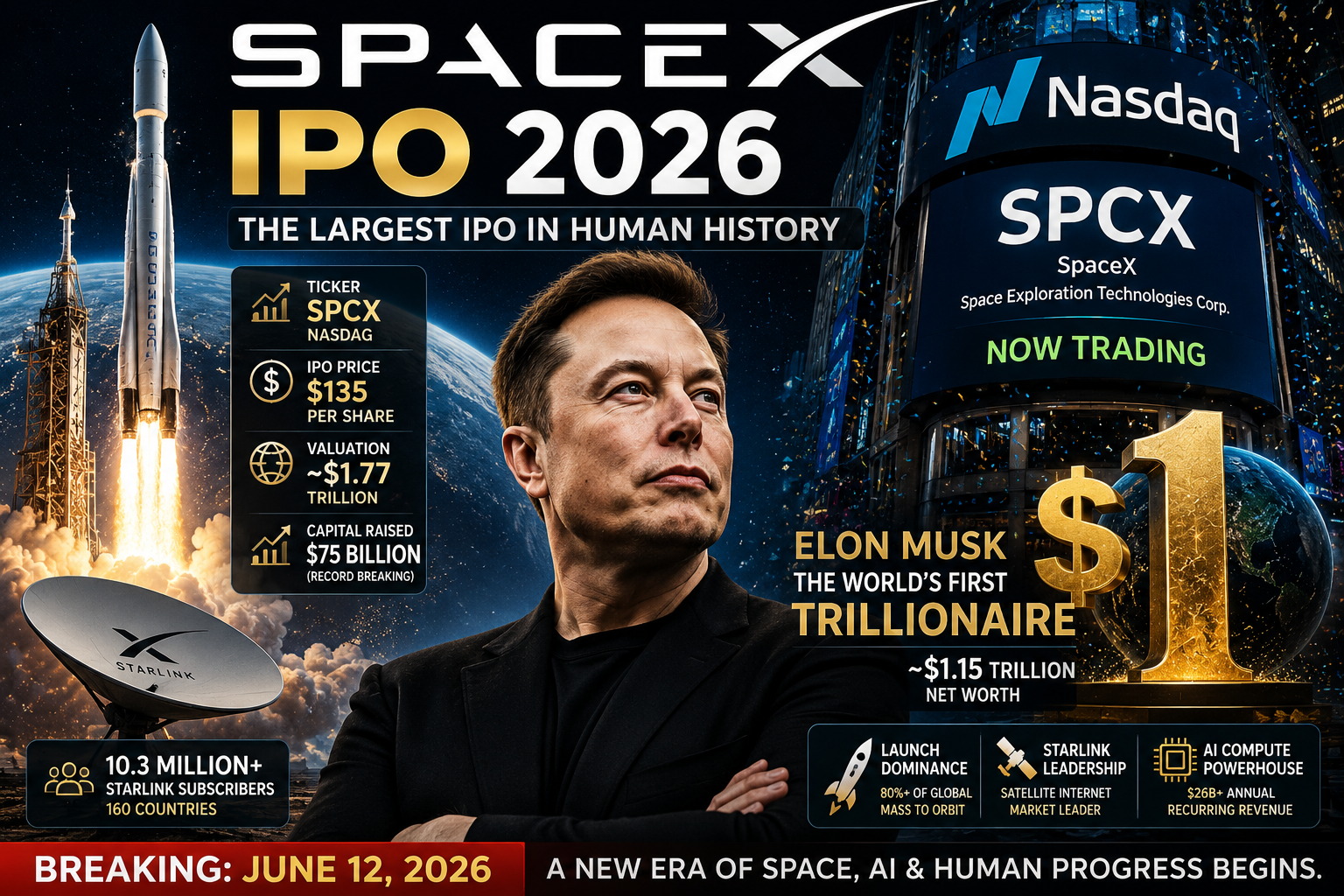
🔴 BREAKING — June 12, 2026: Today marks the most consequential date in the history of global capital markets. The SpaceX IPO — the largest initial public offering ever executed by any company in human history — has officially debuted on the Nasdaq stock exchange under the ticker symbol SPCX, minting the world’s first trillionaire and permanently redrawing the map of the global space and artificial intelligence economy.
🌍 Introduction: The Day Financial History Changed Forever
The SpaceX IPO is not simply a financial event. It is an epoch-defining inflection point — the moment where orbital launch monopoly, satellite internet infrastructure, and hyperscale artificial intelligence compute collide inside a single, publicly traded entity worth approximately $1.77 trillion.
Trading under the ticker SPCX on Nasdaq, Space Exploration Technologies Corp. debuted at a fixed price of $135 per share, raising a historic $75 billion in the largest initial public offering ever executed anywhere on earth. To contextualise that number: the previous global IPO record — Saudi Aramco’s $29.4 billion listing in December 2019 — has been surpassed by nearly three times in a single offering. Investor demand was overwhelming — by the time order books closed, bids had reportedly exceeded $250 billion, oversubscribing the SpaceX IPO by a factor of 3.5x to 4x.
For Elon Musk, the founder and chief executive of SpaceX, the Space Exploration Technologies public offering cements his status as a figure without any historical precedent in economics — the world’s first individual with a notional net worth formally exceeding $1 trillion. At approximately 3% of modern US GDP, this is not merely extraordinary wealth. It is a concentration of private capital that has no parallel in recorded history.
In this comprehensive analysis, we dissect every dimension of the SpaceX IPO 2026 — its financial architecture, the AI-powered revenue machine that underwrites the premium valuation, the mathematics of Musk’s trillionaire status, the systemic governance risk embedded in the SPCX share structure, Senator Elizabeth Warren’s formal SEC intervention, and what the entire event means for Indian retail investors and the rapidly maturing Indian space-technology ecosystem.
📌 SpaceX IPO 2026 — Quick Reference Snapshot
📈 Ticker Symbol: SPCX | 🏛️ Exchange: Nasdaq | 💲 IPO Price: $135 per Share 🏦 Total Capital Raised: $75 Billion | 🌍 Market Cap: ~$1.77 Trillion 🛰️ Starlink Subscribers: 10.3 Million (160 Countries) | 🤖 AI Compute Revenue: $2.17 Billion/Month 🧑💼 CEO: Elon Musk | 💰 Musk Estimated Net Worth: ~$1.15 Trillion 🌐 Largest Sector: Satellite Internet (Starlink) — 61% of Revenue 🏦 Lead Underwriter: Goldman Sachs (21-Bank Syndicate)
📋 SpaceX IPO Structure: Everything Investors Need to Know
The SpaceX initial public offering diverges sharply from conventional Wall Street methodology — and understanding those divergences is essential before making any decision to buy SpaceX stock on the secondary market.
Unlike the standard book-building process — where investment banks canvas institutions across a price range to discover market-clearing demand — SpaceX approached the market with a rigid, fixed-price offering at $135 per share. The company issued 555.6 million Class A shares, and in a critical structural distinction, the entire $75 billion in proceeds flows directly onto SpaceX’s corporate balance sheet. This is a pure primary issuance: no existing insider is exiting at the IPO price. Every dollar raised is earmarked for future capital expenditure across rocket development, satellite constellation expansion, and artificial intelligence infrastructure.
The underwriting syndicate, led by Goldman Sachs as lead-left bookrunner, comprises 21 major global banks — a lineup that signals the institutional gravitas of the Space Exploration Technologies public offering at an unprecedented scale.
🛒 The $22.5 Billion Retail Investor Allocation
One of the most structurally unusual features of the SpaceX IPO is its generous retail allocation. Up to 30% of the total float — approximately $22.5 billion — was reserved specifically for individual retail investors through platforms including Fidelity, Charles Schwab, Robinhood, SoFi, and E*TRADE. This democratisation of access is not purely altruistic. It serves a calculated dual purpose: cultivating a vocal, decentralised shareholder base historically aligned with Musk’s long-term operational narratives, while generating a groundswell of retail momentum capable of countering institutional scepticism about the company’s cash-burn profile.
🔒 The Tiered Lock-Up Release Schedule
Rather than imposing a standard 180-day blanket lock-up on insiders — which can create a sharp, predictable supply surge — SpaceX implemented a tiered, rolling release schedule detailed in the S-1 prospectus filed with the SEC. Existing shareholders may liquidate equity in the following tranches: 20% beginning the second trading day after the first post-IPO quarterly earnings report, an additional 10% if SPCX trades 30% above the $135 IPO price for at least five of the ten preceding trading days, with the remainder unlocked in 7% increments at 70, 90, 105, 120, and 135 days post-listing, and a final 28% released after the third-quarter earnings report. This graduated structure is engineered to prevent the sudden, disorderly flood of insider supply that can crush post-IPO stock prices.
| 📋 SpaceX IPO Metric | 📌 Specification |
|---|---|
| 🏷️ Ticker / Exchange | SPCX / Nasdaq |
| 💲 Fixed Offer Price | $135 per Share |
| 📦 Shares Offered | 555.6 Million Class A |
| 💰 Capital Raised | $75 Billion |
| 🌍 Implied Market Capitalisation | ~$1.75 – $1.77 Trillion |
| 🛒 Retail Allocation | Up to 30% (~$22.5 Billion) |
| 📈 Oversubscription Level | >$250 Billion (3.5x–4.0x) |
| 🏦 Lead Underwriter | Goldman Sachs |
| 🏛️ Syndicate Size | 21 Banks |
| 🌏 Previous Global IPO Record | Saudi Aramco ($29.4B, 2019) |
| 👷 Employees Becoming Millionaires | 4,400+ Expected |
| 💎 Employees Netting $100M+ | ~400 Individuals |
💰 The $1.77 Trillion Valuation Decoded: Three Businesses, One Ticker
At 94 times trailing 2025 revenue, the SpaceX IPO valuation is extraordinary by any traditional financial metric. To understand how the market arrived there, you must analyse Space Exploration Technologies not as a rocket manufacturer, but as a three-pronged technology infrastructure conglomerate spanning space launch, satellite broadband, and AI compute.
🛰️ Pillar 1 — Starlink: The Only Profitable Engine
Starlink, SpaceX’s low-earth orbit (LEO) satellite internet service, is the financial bedrock of the entire operation. By Q1 2026, Starlink had reached 10.3 million active subscribers globally, operating a network of over 9,600 LEO satellites deployed across 160 countries — cementing its status as the world’s dominant commercial satellite broadband provider.
In fiscal year 2025, Starlink generated $11.4 billion in revenue, representing a commanding 61% of SpaceX’s consolidated $18.7 billion top line. Crucially, Starlink is the organisation’s only profitable division, operating at a highly efficient 63% adjusted EBITDA margin and generating $4.42 billion in operating income — the indispensable cash-flow floor that subsidises the company’s more speculative, capital-intensive ambitions across rocket development and AI.
One material headwind disclosed in the S-1 demands attention: the average revenue per user (ARPU) has declined from $99/month in 2023 to just $66/month by early 2026, indicating that continued subscriber growth increasingly depends on penetrating highly price-sensitive developing markets where premium pricing is not sustainable.
🚀 Pillar 2 — Space Launch: The Insurmountable Competitive Moat
SpaceX’s foundational business — the design, manufacture, and operation of the Falcon 9, Falcon Heavy, Dragon capsule, and the developmental Starship super-heavy launch vehicle — generated $4.1 billion in revenue in 2025, with an estimated $0.7 billion in operating profit. The absolute revenue contribution is modest relative to Starlink, but the strategic moat it provides is immeasurable.
By executing over 650 successful launches since 2023 and accounting for more than 80% of all global mass delivered to orbit in 2025, SpaceX has achieved a functional monopoly on commercial access to space. Through rigorous reusability engineering, the company has slashed the cost of orbital delivery by 92% compared to historical aerospace norms, achieving approximately $1,400 per kilogram on Falcon Heavy payloads. Starship, currently undergoing advanced orbital testing, is engineered to drive that cost down by a further 99% upon full commercialisation — a technological leap that would make near-total control of the global launch market essentially permanent.
🤖 Pillar 3 — Artificial Intelligence: The Controversial, Capital-Consuming Bet
The most contentious component of the Space Exploration Technologies IPO valuation is its AI infrastructure buildout. Despite delivering 33% year-over-year revenue growth in 2025, SpaceX reported a massive GAAP net loss of $4.94 billion for the full fiscal year — a sharp reversal from the $791 million profit posted in 2024. The acceleration into 2026 has been even more dramatic: the company posted a $4.28 billion net loss in Q1 2026 alone, bringing its total accumulated deficit to $41.3 billion.
The singular driver of this financial deterioration is aggressive AI capital expenditure — $17.8 billion in the last twelve months — triggered primarily by the February 2026 all-stock merger with Elon Musk’s artificial intelligence venture, xAI, which was valued at $250 billion at the time of acquisition. To further shore up its balance sheet ahead of the SpaceX public offering, the company reportedly secured a $20 billion bridge loan from a banking consortium in April 2026, with potential repayment from incoming IPO proceeds if not settled through alternative channels within six months.
| 📊 Financial Metric | 📅 2024 | 📅 2025 | 📅 Q1 2026 |
|---|---|---|---|
| 🏦 Consolidated Revenue | $14.0 Billion | $18.7 Billion | $4.69 Billion |
| 🛰️ Starlink Revenue | N/A | $11.4 Billion | N/A |
| 📉 Net Income / (Loss) | +$791 Million | ($4.94 Billion) | ($4.28 Billion) |
| 🤖 AI / Supercomputer Capex | N/A | $17.8B (LTM) | $7.72 Billion |
| ⚠️ Accumulated Deficit | — | — | $41.3 Billion |
| 📈 YoY Revenue Growth | — | ~33% | — |
🏢 The AI Compute Landlord: How SpaceX Turned a Power Crisis Into $26 Billion Per Year
The absorption of xAI into SpaceX is the corporate masterstroke that makes the $1.77 trillion SpaceX IPO valuation genuinely intelligible to serious institutional capital. The transaction sequence is a study in sophisticated financial engineering.
The chain of value creation originated with Elon Musk’s highly leveraged $44 billion buyout of Twitter in 2022. In March 2025, X (formerly Twitter) was converted into xAI shares in a deal valuing xAI at $80 billion and X at roughly $33 billion in equity. Less than twelve months later, in February 2026, SpaceX acquired xAI in an all-stock transaction valuing the AI venture at $250 billion and the combined enterprise at $1.25 trillion. For co-investors who had faced deep paper losses on their original Twitter equity, this financial alchemy delivered a threefold return on their xAI conversion in under twelve months — just in time for the SpaceX IPO listing.
⚡ Exploiting the Global Power Bottleneck
The broader AI industry in 2026 is paralysed by a single physical constraint: electrical power. Sovereign power grids typically require five to ten years to approve and connect gigawatt-scale data facilities. SpaceX bypassed this gridlock entirely through speed-to-deployment that no regulated utility could match.
SpaceX constructed the “Colossus” data centre campus outside Memphis, Tennessee — Colossus 1 was erected in a record 122 days, housing over 220,000 Nvidia H100, H200, and GB200 GPUs drawing 300 megawatts of power. When xAI subsequently migrated its proprietary Grok AI model training operations to the newer and larger Colossus 2 facility — a repurposed industrial factory engineered for gigawatt-scale power capacity to house 550,000 next-generation GPUs — SpaceX was left controlling a massive, vacant world-class computing cluster with extraordinary inherent rental value.
Rather than letting that capacity sit idle, SpaceX pivoted into a hyperscale compute landlord for its own most formidable competitors — with financial results that transformed the entire investment thesis for the SpaceX public offering.
🔵 The Anthropic Contract: $40 Billion in Lifetime Value
In May 2026, Anthropic — the AI safety company and creator of the Claude AI assistant — agreed to lease the entirety of Colossus 1 from SpaceX at $1.25 billion per month through May 2029. The contract carries a lifetime value exceeding $40 billion. For Anthropic, whose annualised recurring revenue exploded from $1 billion in January 2025 to $35 billion by May 2026, the $15 billion annual compute expenditure purchases complete independence from cloud infrastructure giants like Amazon Web Services and Google Cloud, dramatically improving Anthropic’s negotiating leverage with both platforms.
🔴 The Google Contract: $30 Billion and the Great Irony
On June 5, 2026 — just one week before the SpaceX IPO — Alphabet’s Google committed to paying $920 million per month through June 2029 for access to 110,000 Nvidia GPUs, CPUs, and associated computing hardware at the Colossus facility — a contract worth approximately $30 billion over its lifetime. The Google agreement contains strict performance triggers: failure to deliver guaranteed compute capacity by September 30 grants Google the right to terminate after a one-month grace period.
The profound irony here cannot be overstated. Google invested $900 million into SpaceX back in 2015, a stake now valued between $100 billion and $126 billion at the IPO price. Google is now paying $920 million per month to rent computing infrastructure from a company it partially owns — effectively subsidising SpaceX’s cash flow precisely because Google’s own internal cloud expansion could not clear the physical power bottleneck fast enough to meet internal AI training demand.
Collectively, the Anthropic and Google contracts generate $2.17 billion per month — over $26 billion annually in high-margin, recurring revenue. This single revenue stream eclipses SpaceX’s entire 2025 consolidated revenue of $18.7 billion — and it didn’t exist eighteen months ago.
| 🏢 Tenant | 💼 Lifetime Contract Value | 📅 Duration | 💲 Monthly Fee | 🖥️ Compute Leased |
|---|---|---|---|---|
| 🔵 Anthropic | ~$40 Billion | Through May 2029 | $1.25 Billion | 300 MW / 220,000 GPUs |
| 🔴 Google (Alphabet) | ~$30 Billion | Through Jun 2029 | $920 Million | 110,000 GPUs + CPUs |
| 📊 Combined Total | ~$70 Billion | — | $2.17 Billion/Mo | — |
🌌 Musk’s Orbital Data Centre Vision: SpaceX has articulated plans to launch “orbital data centres” — deploying gigawatts of server capacity into low earth orbit, powered perpetually by unobstructed solar energy, completely circumventing terrestrial grid constraints. The stated long-term ambition is to scale to 1,000 times current terrestrial capacity from a future manufacturing base on the Moon.
👑 Elon Musk: The Mathematics of the World’s First Trillionaire
The SpaceX IPO places Elon Musk in genuinely uncharted economic territory. Here is the precise architecture of his notional $1.15 trillion net worth.
Musk’s beneficially owned 717.1 million Tesla shares, priced near $399.15 at mid-2026, carry a market value of approximately $286.2 billion (view TSLA on Nasdaq). His combined Class A and Class B holdings in SpaceX — representing roughly 42% of total company equity — are valued at approximately $866.5 billion at the $135 IPO price, yielding a combined notional net worth of approximately $1.15 trillion.
This figure is more than three times the fortune of the world’s second-richest individual — Google co-founder Larry Page, whose fortune hovers around $304 billion (Bloomberg Billionaires Index).
⚠️ The Conditional Caveat: The “Marsshot” Performance Awards
A critical nuance buried in the SpaceX S-1 prospectus significantly complicates the trillionaire headline. A substantial portion of Musk’s calculated wealth includes performance-based restricted stock units with vesting conditions of truly extraordinary ambition:
The initial 1 billion-share tranche requires SpaceX to simultaneously achieve a $7.5 trillion market capitalisation AND establish a permanent human colony on Mars with at least 1 million inhabitants. A secondary award, replacing his prior xAI compensation package, requires the deployment of 100-terawatt data centres in space and clearing twelve sequential valuation milestones up to $6.6 trillion.
Excluding these speculative “Marsshot” awards, Musk’s baseline equity positions him slightly below the $1 trillion threshold — meaning his official trillionaire status is materially sensitive to post-IPO secondary market price discovery.
🏛️ The New Gilded Age: Historical Wealth Comparisons That Put Musk in Context
Economic historians reacted immediately to the SpaceX IPO by drawing comparisons to America’s original Gilded Age — the era of rapid industrial expansion defined by magnates known colloquially as the “Robber Barons”. At a $1 trillion valuation, Musk commands roughly 3% of modern US GDP — double the relative economic footprint of Standard Oil founder John D. Rockefeller at the time of his death in 1937, whose $1.4 billion fortune represented 1.5% of GDP.
Professor Guido Alfani of Bocconi University offers a vivid alternative metric: measuring extreme wealth by the volume of human labour it can theoretically command. By this measure, Musk’s fortune could purchase the labour of 557,800 workers in 2025 — vastly overshadowing Rockefeller’s 116,000 or Carnegie’s 48,000. Alfani concludes that, excluding emperors or rulers whose wealth was indistinguishable from the state itself, Elon Musk is likely the wealthiest individual to have ever lived.
| 🏅 Historical Magnate | 💰 Net Worth (At Death/Current) | 📊 % of US GDP | 👷 Labour Equivalency |
|---|---|---|---|
| 🏠 John Jacob Astor (1848) | $20M – $30M | ~1.0% | — |
| 🔩 Andrew Carnegie (1919) | $380 Million | ~0.5% | 48,000 Workers |
| 🛢️ John D. Rockefeller (1937) | $1.4 Billion | ~1.5% | 116,000 Workers |
| 💻 Larry Page (2026) | $304 Billion | <1.0% | — |
| 🚀 Elon Musk (2026) | ~$1.15 Trillion | ~3.0% | 557,800 Workers |
💸 The Philanthropy Divide: Carnegie vs. Musk
Where Musk diverges most sharply from his Gilded Age predecessors is in the deployment of capital for public good. Andrew Carnegie’s 1889 “Gospel of Wealth” argued that fortunes should be entirely deployed for public benefit during an individual’s lifetime — and Carnegie donated 90% of his wealth before death, funding universities, libraries, and hospitals across two continents.
Musk signed the Giving Pledge in 2012, committing to donate the majority of his wealth. However, influential figures in the conservative technology ecosystem — led by venture capitalist Peter Thiel, a long-term Musk associate — have actively lobbied billionaires to abandon the initiative, characterising it as an “Epstein-adjacent, fake Boomer club” that routes capital toward “left-wing nonprofits.”
Musk’s charitable contributions have remained concentrated in opaque donor-advised funds ($37 million to Vanguard Charitable; $39 million to Fidelity Charitable) or directed toward causes directly intersecting with his commercial ventures — signalling a broader ideological rejection of traditional large-scale philanthropy that has no precedent at this wealth level.
📊 The Inequality Reality Check: Oxfam reports that if Musk were to spend $1 million every single day, it would take 2,740 years to deplete a $1 trillion fortune. French economist Gabriel Zucman, preparing a report for the G20’s Brazilian presidency, estimates that a global 2% minimum wealth tax levied on just 3,000 billionaires could generate roughly $250 billion annually — equivalent to lifting 3.8 billion people out of poverty.
⚠️ Governance Red Flags: Who Really Controls SPCX Stock?
🗳️ The Dual-Class Share Structure: Shareholders Without a Voice
Public investors in the SpaceX IPO should understand, with absolute clarity, that the SPCX shares they purchase carry essentially no meaningful governance power. Under the corporate bylaws filed with the SEC, Musk holds 849.5 million Class A shares (carrying one vote per share) alongside 5.57 billion Class B super-voting shares carrying ten votes per share. The combined result: Musk retains 84.4% to 85% of total voting power across all corporate decisions — strategy, executive compensation, capital allocation, acquisitions, and beyond.
The company additionally mandates mandatory arbitration for shareholder disputes and exploits Texas corporate law to enforce strict restrictions on shareholder proposals — creating near-insurmountable barriers to accountability. At the projected valuation, a shareholder would need to hold billions of dollars in SPCX stock simply to reach the 3% ownership threshold required to initiate legal action against the board.
📉 The Passive Index Buying Squeeze: Your Retirement Savings at Risk
While the S&P 500 correctly maintained its established inclusion criteria — which correctly exclude SpaceX due to both its massive losses and its tiny public float — other major indices modified their rules to capture the SpaceX IPO inflows under intense lobbying pressure.
Effective May 1, 2026, the Nasdaq-100 introduced a “Fast Entry” rule permitting top-40 market-cap companies to enter the index after just 15 trading days, simultaneously eliminating the previous 10% minimum float requirement and replacing it with a 3x multiplier for low-float stocks. The Russell 1000 adopted an even more aggressive posture, allowing mega-cap IPOs to enter just 5 trading days post-listing.
Bloomberg Intelligence estimates that inclusion across these fast-entry indices will mechanically compel passive funds to absorb up to 24% of the publicly available float within the first three weeks of SPCX trading — regardless of SpaceX’s profitability, its cash burn, or any independent valuation assessment. Most critically, both the Russell’s 5-day and Nasdaq’s 15-day windows fall entirely within the SEC Regulation M stabilisation period — the legal timeframe during which IPO underwriters are permitted to artificially support the share price through open-market purchases. This means the retirement savings of working-class Americans may be compelled to buy SPCX stock at artificially elevated, underwriter-supported prices, before genuine free-market price discovery has had the chance to occur.
🏛️ Senator Warren’s Regulatory Intervention: June 9, 2026
On June 9, 2026, Senator Elizabeth Warren (D-Mass.) issued a formal 12-page letter to SEC Chair Paul Atkins, demanding an immediate delay of the SpaceX IPO. Warren’s intervention rested on several interconnected arguments: severe risks to working-class retirement accounts from forced passive buying at potentially inflated prices; the index rule modifications as “a scheme of financial engineering that rigs America’s capital markets in favor of Mr. Musk and other SpaceX insiders“; national security vulnerabilities from anonymous foreign capital inflows into a premier US defence contractor with classified government launch contracts; and market analyst characterisations of the valuation math as “nonsensical” and based on “smoke-and-mirrors accounting.” Despite the political pressure, the SEC had already cleared the registration statement, and the SpaceX IPO proceeded without delay.
🌏 Global Contagion: The SpaceX IPO and India’s Space-Tech Revolution
The SpaceX IPO 2026 is not a self-contained American capital markets event. As the gravitational anchor for the entire $626 billion global space economy, the transition of Space Exploration Technologies to a publicly traded benchmark immediately forces a re-rating of alternative space-technology assets in every market worldwide. As passive index funds and institutional behemoths deploy capital into SPCX at a 94x revenue premium, active fund managers will aggressively seek geographically diversified, cost-advantaged proxies to generate alpha — and the clearest beneficiary is the rapidly maturing Indian private space-technology sector.
🦄 Skyroot Aerospace: India’s First Space-Tech Unicorn
The most tangible early ripple of the SpaceX IPO for the Indian market was crystallised in May 2026, when Hyderabad-based launch provider Skyroot Aerospace closed a $60 million Series C funding round, elevating its valuation to $1.1 billion — making it officially India’s first space-tech unicorn.
The composition of Skyroot’s investor base is deeply instructive. The round was anchored by Singapore’s sovereign wealth fund GIC, BlackRock-managed funds, and Silicon Valley pioneer Ram Shriram’s Sherpalo Ventures. These are not speculative venture capital tourists — they are institutional titans explicitly modelling the structural tailwinds created by SpaceX’s monopolisation of Western launch capacity.
Skyroot’s Vikram-1 orbital launch vehicle, scheduled for its maiden flight from the Satish Dhawan Space Centre at Sriharikota in June 2026, targets 340 kg payloads into low Earth orbit — precisely the mass range in chronic global supply shortage for on-demand, dedicated small-satellite deployment. Leveraging India’s deeply established labour-cost-advantaged engineering talent pool and a stated 72-hour assembly-to-launch capability, Skyroot offers a logistical agility that traditional aerospace primes from Arianespace to ULA cannot replicate at comparable economics.
🏭 Indian “Picks and Shovels” Proxy Plays for the Space-Tech Supercycle
For Indian retail and institutional investors seeking indirect exposure to the global space economy re-rating triggered by the SpaceX IPO, the domestic secondary market offers several compelling options in precision-engineering hardware and aerospace electronics. MTAR Technologies — a leading supplier of precision-machined components to ISRO and private launch customers — Data Patterns India in defence electronics, Bharat Electronics Ltd (BEL), and Hindustan Aeronautics Ltd (HAL) are all positioned for valuation multiple expansion as global capital formally legitimises the space-tech vertical through the SpaceX IPO benchmark.
Furthermore, IN-SPACe — India’s National Space Promotion and Authorisation Centre — has begun injecting developmental capital into startups like SatSure Analytics India to build AI models for satellite remote sensing, integrating the domestic ecosystem into the global data economy that the SpaceX IPO has now formally placed on the institutional investment map.
🇮🇳 How Indian Investors Can Buy SpaceX Stock (SPCX) in 2026
Direct allocation in the SpaceX IPO is structurally closed to Indian residents due to US underwriting syndicate constraints — the retail lottery operated by Fidelity, Schwab, Robinhood, SoFi, and E*TRADE was limited to US-domiciled accounts. However, following the open of secondary market trading on June 12, Indian capital has two legitimate access routes.
Route 1 — Direct SPCX Purchase via the RBI Liberalised Remittance Scheme (LRS): Under the Reserve Bank of India’s LRS framework, Indian residents may remit up to USD 250,000 per financial year for direct overseas investment in listed equities. Platforms enabling SPCX purchases for Indian residents include Vested Finance and Appreciate, both of which offer LRS-compliant direct access to US-listed stocks.
⚠️ Expert Caution: Vested Finance CEO Viram Shah explicitly recommends a staggered, systematic deployment strategy for SPCX rather than lump-sum entry, recognising that post-IPO volatility — driven by the tiered lock-up release schedule, the forced passive index buying events, and the sheer scale of the $75 billion float — is likely to produce significant price dislocations in the initial months of trading.
Route 2 — Indian Space-Tech Proxy Stocks: For investors preferring rupee-denominated exposure without currency conversion and remittance complexity, the NSE and BSE listings of MTAR Technologies, Data Patterns, BEL, and HAL offer credible indirect exposure to the global space economy re-rating catalysed by the SpaceX IPO.
📈 SpaceX IPO Investment Risk Assessment
Before making any decision to buy SPCX stock or participate in SpaceX IPO-adjacent investments, these risk factors demand careful consideration:
🔴 High-Risk Factors: SpaceX carries a $41.3 billion accumulated GAAP deficit with no clear short-term profitability timeline. The $4.28 billion net loss in Q1 2026 alone signals accelerating cash burn. Musk’s 84–85% voting power means public shareholders have no meaningful governance recourse whatsoever. The $20 billion bridge loan creates potential balance sheet pressure if the capital markets environment deteriorates. The regulatory risk from Warren’s SEC intervention — while ultimately unsuccessful — signals ongoing political scrutiny. Forced passive buying at potentially stabilisation-supported prices creates a dangerous mis-pricing window.
🟡 Medium-Risk Factors: The Starlink ARPU decline from $99 to $66/month represents genuine margin pressure. AI compute capex of $17.8 billion annually demands sustained capital access. The Google lease includes a performance clause that allows termination if compute capacity falls short by September 30.
🟢 Bullish Catalysts: The $2.17 billion per month in recurring compute revenue from Anthropic and Google alone exceeds all of SpaceX’s 2025 consolidated revenues. The 80%+ monopoly share of global orbital mass represents a structural barrier to entry that no competitor is positioned to overcome within this decade. Starlink’s 63% EBITDA margins across 10.3 million subscribers in 160 countries provide a genuine cash-flow foundation. Starship commercialisation could deliver cost advantages of 99% over legacy rockets, permanently extending the launch moat.
❓ SpaceX IPO 2026 — Frequently Asked Questions
Q1. What is the SpaceX IPO price per share? The SpaceX IPO is priced at a fixed $135 per share, trading on the Nasdaq under the ticker symbol SPCX. Unlike most IPOs, there was no price range or book-building process — the $135 price was set as a non-negotiable fixed offering.
Q2. What is SpaceX’s market capitalisation after the IPO? The Space Exploration Technologies Corp. IPO implies a market capitalisation of approximately $1.75 trillion to $1.77 trillion, making SPCX one of the largest companies on earth by market value at debut.
Q3. How much money did SpaceX raise in its IPO? SpaceX raised $75 billion through the issuance of 555.6 million Class A shares — making it the largest IPO in global history, surpassing Saudi Aramco’s $29.4 billion listing in December 2019 by nearly three times.
Q4. Is Elon Musk officially a trillionaire after the SpaceX IPO? Based on his combined Tesla and SpaceX equity holdings (~42% of SpaceX), Musk’s notional net worth is approximately $1.15 trillion at the SpaceX IPO price — formally the world’s first individual trillionaire. However, a significant portion of this figure includes highly speculative Marsshot RSU conditions, including establishing a 1-million-person colony on Mars.
Q5. Can Indian investors buy SpaceX stock (SPCX)? Indian investors cannot participate in the IPO allocation directly, but may legally purchase SPCX in the secondary market via the RBI Liberalised Remittance Scheme (LRS) through platforms like Vested Finance or Appreciate. Indian investors can also gain indirect exposure through domestic space-tech proxy stocks on NSE and BSE.
Q6. What revenue multiple does the SpaceX IPO valuation represent? The SpaceX IPO values Space Exploration Technologies at approximately 94 times trailing 2025 revenue of $18.7 billion — a premium justified by the $26 billion in annualised recurring AI compute revenue (Anthropic + Google contracts), Starlink’s growth trajectory, and the launch sector monopoly.
Q7. What is the SpaceX Nasdaq ticker symbol? SpaceX trades on the Nasdaq under the ticker symbol SPCX.
Q8. How does the SpaceX IPO affect Indian space stocks? The SpaceX IPO has accelerated global institutional capital rotation into emerging space-tech markets. Skyroot Aerospace became India’s first space-tech unicorn in direct response. Domestic aerospace component suppliers including MTAR Technologies, Data Patterns, BEL, and HAL are positioned for significant valuation multiple expansion as the space economy receives formal institutional benchmarking.
Q9. Why did Senator Warren oppose the SpaceX IPO? Senator Warren issued a formal letter to SEC Chair Paul Atkins on June 9, 2026, citing risks to working-class retirement accounts from forced passive index buying, Musk’s 85% voting-power lock on governance, national security vulnerabilities from foreign capital inflows into a critical US defence contractor, and analyst concerns about the valuation methodology.
Q10. Who are the best Indian proxy stocks for the SpaceX IPO space boom? The most directly exposed Indian proxy stocks are MTAR Technologies (precision aerospace engineering), Data Patterns India (defence electronics), Bharat Electronics Ltd / BEL (government aerospace systems), and Hindustan Aeronautics Ltd / HAL (India’s largest aerospace manufacturer).
Q11. What is Starlink’s current subscriber count and revenue? As of Q1 2026, Starlink has 10.3 million active subscribers across 160 countries, operating a fleet of over 9,600 LEO satellites. Starlink generated $11.4 billion in revenue in 2025, representing 61% of SpaceX’s total revenue.
Q12. What is the Skyroot Aerospace Vikram-1 rocket and when does it launch? Skyroot’s Vikram-1 is an orbital launch vehicle capable of carrying 340 kg payloads to low Earth orbit, with its maiden flight from Satish Dhawan Space Centre, Sriharikota, scheduled for June 2026.
🎯 Conclusion: The Trillion-Dollar Orbit Has Officially Begun
The SpaceX IPO 2026 is not merely a record-breaking financial transaction. It is the formal inauguration of an entirely new industrial paradigm — one where orbital launch monopoly, global satellite broadband, and hyperscale AI compute infrastructure are fused under the absolute operational control of a single individual, publicly traded on the world’s most liquid stock exchange.
Elon Musk’s elevation to the world’s first trillionaire underscores a concentration of wealth and technological power that eclipses the Gilded Age magnates in every measurable dimension — commanding 3% of US GDP, capable of purchasing the labour of 557,800 workers, and classified by leading economic historians as the wealthiest individual to have ever lived. The $26 billion in annualised compute revenue from Anthropic and Google — fierce competitors paying billions per month to rent infrastructure from a company they partially compete with and partially own — demonstrates that SpaceX is no longer a transportation company. It is the foundational landlord of the AI infrastructure era.
As SPCX begins trading on the Nasdaq and passive index inclusion mechanics force trillions in retirement capital into a low-float, dual-class-governance mega-cap, the global space economy will never look the same. India’s Skyroot Aerospace becoming a unicorn is just the first geopolitical ripple. The proxies — MTAR, Data Patterns, BEL, HAL — are being re-rated in real time. The SpaceX IPO has permanently legitimised the space-tech vertical for institutional capital worldwide.
The trillion-dollar orbit has only just begun its trajectory. 🚀🌍
⚠️ Disclaimer: This article is published strictly for informational and educational purposes and does not constitute financial, investment, or legal advice. Investing in IPO stocks such as SPCX or any related space-tech securities involves significant risk, including possible total loss of invested capital. Indian investors should consult a SEBI-registered investment advisor before making any international or domestic investment decisions.
🏷️ Tags & SEO Keywords: SpaceX IPO, SpaceX IPO 2026, SPCX stock, SpaceX IPO price, SpaceX Nasdaq, largest IPO in history, Elon Musk trillionaire, SpaceX valuation 2026, how to buy SpaceX stock, SpaceX IPO India, buy SPCX from India, Starlink IPO, SpaceX Starlink subscribers, xAI SpaceX merger, space stocks 2026, space technology investment, SpaceX IPO analysis, SpaceX IPO risks, SpaceX share price, orbital launch vehicle, satellite internet stocks, Skyroot Aerospace unicorn, Indian space stocks, MTAR Technologies, Data Patterns India, LRS scheme SpaceX, Vested Finance SPCX, commercial space sector 2026, space economy, Space Exploration Technologies Corp IPO, SpaceX goes public, SpaceX initial public offering, Elon Musk net worth 2026, Anthropic SpaceX, Google SpaceX compute lease, Colossus data centre, Starship rocket IPO, low earth orbit satellites