

Table of contents
- 🔑 Key Takeaways at a Glance
- 🌐 Introduction: Why 86 Jobs Are Worth $2 Trillion of Your Attention
- 📋 Section 1: The Salesforce June 2026 Layoffs — A Surgical Strike, Not a Panic 🎯
- ⏳ Section 2: Salesforce Layoff Timeline 2024–2026 — A Pattern Hiding in Plain Sight
- 💰 Section 3: Salesforce Severance Package 2026 — Full Industry Breakdown
- 💥 Section 4: The SaaSpocalypse Explained — Understanding a $2 Trillion Market Wipeout 📉
- 📊 Section 5: The Financial Paradox — Record Revenue While the Stock Gets Hammered 🤯
- 🤖 Section 6: Agentforce AI — From Zero to $1.2 Billion ARR and the Consumption Model Revolution
- Agentforce Financial Performance: Q1 FY27 🚀
- 🧠 Agentic Work Units (AWUs): The New Metric That Replaces “Seats”
- 🏪 From AppExchange to AgentExchange: The Brand Transition
- 🌍 Real-World Agentforce Enterprise Deployments at Scale
- 💬 Slack: Repositioned as the Operating System of the Agentic Enterprise
- 🏗️ Headless 360: The Architecture That Future-Proofs Salesforce
- 👨💻 Section 7: Salesforce Engineering Hiring Freeze 2026 — The Productivity Transformation That Changes Everything
- 🌍 Section 8: Industry-Wide Tech Layoffs 2026 — The AI Restructuring Contagion Is Systemic
- ❓ Section 9: FAQ — Salesforce Layoffs 2026 — Everything You Need to Know
- 🔭 Section 10: Strategic Outlook — Three Trajectories for Enterprise Software in the Agentic Era
- 🎯 Conclusion: 86 Jobs. $2 Trillion Story. One Industry in Metamorphosis.
- 🏷️ Topics & Keywords
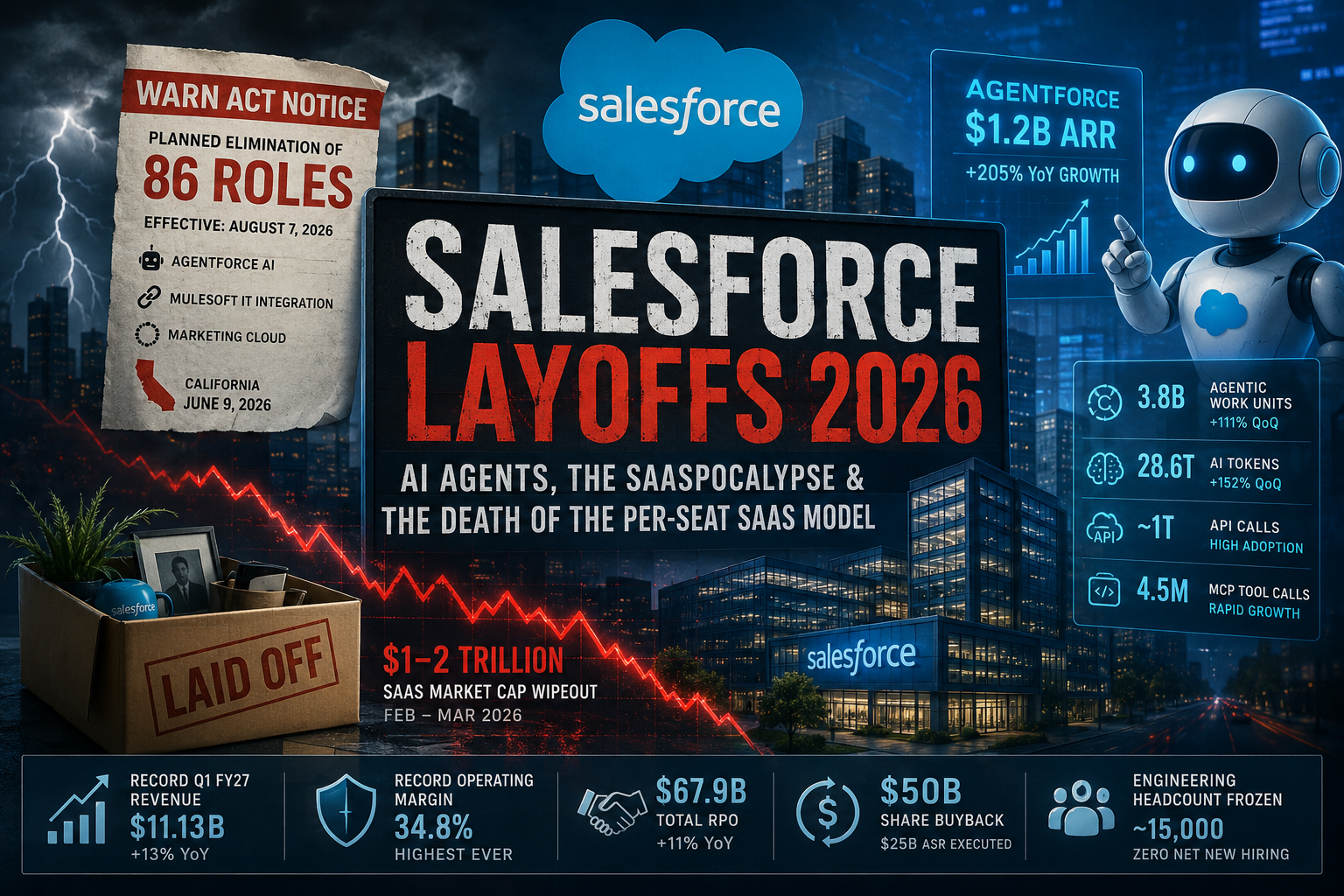
📌 BREAKING NEWS: On June 9, 2026, Salesforce submitted a California WARN Act notice formally eliminating 86 roles. But this story goes far beyond 86 jobs — it is the single most symbolic data point in a $1–2 trillion market reckoning reshaping enterprise software forever.
🔑 Key Takeaways at a Glance
- ✅ Salesforce filed official California WARN Act notices on June 9, 2026, confirming elimination of 86 roles
- ✅ Targeted divisions: Agentforce AI, MuleSoft IT Integration, and Marketing Cloud
- ✅ Cuts extended internationally — approximately 30 roles eliminated in Ireland plus reductions in Seattle and Bellevue, Washington
- ✅ Salesforce has reduced its workforce by an estimated 5,000+ cumulative roles since 2024, largely attributed to AI automation
- ✅ Despite layoffs, Q1 FY27 revenue reached a record $11.13 billion — up 13% year-over-year
- ✅ Agentforce AI ARR surpassed $1.2 billion — a massive 205% year-over-year surge
- ✅ The “SaaSpocalypse” erased an estimated $1–2 trillion in SaaS market capitalisation between February and March 2026
- ✅ Salesforce engineering headcount frozen at ~15,000 — zero net new software engineers planned for FY26/27
- ✅ A complex system migration estimated at 231 days was shipped in just 13 days using AI coding tools
🌐 Introduction: Why 86 Jobs Are Worth $2 Trillion of Your Attention
When a corporation employing over 80,000 people globally files a WARN Act notice for 86 employees, most financial desks wouldn’t look twice.
But the Salesforce layoffs of June 2026 demand a very different level of analysis — because what they represent is not a routine rounding error in corporate headcount management. They are a precise, surgical signal of the most consequential structural transformation the enterprise software industry has experienced in its 30-year history.
The Salesforce workforce reduction announced on June 9, 2026 sits at the exact intersection of three seismic economic forces: the commercial maturation of autonomous AI agents, the structural collapse of the per-seat SaaS licensing model that built trillion-dollar valuations throughout the 2010s, and what financial analysts are now calling the “SaaSpocalypse” — a panic-driven market repricing event that eradicated an estimated $1–2 trillion in software equity value across a single six-week window.
This comprehensive analysis breaks down everything: what happened, why it happened, who was targeted, what the Salesforce severance package looks like for impacted employees, how the SaaS market crash of 2026 connects to AI agents replacing human software users, and — most critically — what the agentic enterprise transition means for the future of tech employment, SaaS stock valuations, and the global enterprise software economy at large.
📋 Section 1: The Salesforce June 2026 Layoffs — A Surgical Strike, Not a Panic 🎯
What the WARN Act Filing Reveals
On June 9, 2026, Salesforce formally submitted a California WARN Act filing with the state’s Employment Development Department (EDD), confirming the planned elimination of 86 California-based roles. Under the federal and California Worker Adjustment and Retraining Notification Act, employers with 100 or more employees must provide 60 days of advance notice before any qualifying mass layoff — meaning all affected workers remain on the Salesforce payroll through August 7, 2026.
The Salesforce 2026 job cuts extended well beyond California. Reporting confirmed targeted reductions across:
- 🌎 Washington State — Seattle and Bellevue corporate offices
- 🌍 Ireland — approximately 30 personnel at the company’s European base
- 🌏 Various international outposts across the global operational footprint
Salesforce currently employs over 80,000 people worldwide and maintains a workforce of more than 2,600 employees in Canada alone, illustrating the narrow, precisely targeted nature of the June 2026 event.
Which Teams Were Affected? 🗂️
| 🏢 Division | Strategic Role at Salesforce | Why It Was Targeted |
|---|---|---|
| Agentforce AI | Flagship autonomous AI platform | Post-product-launch rationalisation — peripheral project teams dissolved after reaching general availability |
| MuleSoft | Enterprise IT integration platform | AI agents increasingly replace human-managed API workflows and system connectivity layers |
| Marketing Cloud | B2B/B2C marketing automation suite | Generative AI models replacing manual campaign orchestration previously requiring human operators |
💡 Critical Context: Internal sources confirmed that the Agentforce reductions did not affect the core LLM engineering, infrastructure, or model development teams. Only peripheral project-based roles were dissolved after the product achieved general availability and market scale. This is standard post-launch rationalisation — Salesforce is not retreating from AI. It’s removing the scaffolding after the building is complete.
⏳ Section 2: Salesforce Layoff Timeline 2024–2026 — A Pattern Hiding in Plain Sight
The June 2026 WARN Act filing is not an isolated event. The Salesforce AI workforce restructuring is the latest milestone in a sustained, multi-year operational leaning strategy that has quietly transformed one of the world’s largest software businesses.
📅 The Complete Salesforce Layoffs Timeline
🔴 2024 — The Support Division Transformation (−4,000 Roles)
Salesforce quietly eliminated approximately 4,000 customer support roles, shrinking the support division from 9,000 to roughly 5,000 employees — a staggering 44% contraction in a single functional unit. CEO Marc Benioff explicitly credited autonomous AI agents with absorbing the vast majority of routine Tier 1 and Tier 2 customer service interactions, enabling the enterprise to “rebalance” its support headcount as AI autonomously handled what previously required full-time human operators.
🔴 Late January–February 2026 — Analytics, Heroku, and Product Cuts (−1,000 Roles)
Salesforce eliminated approximately 1,000 roles across marketing, product management, data analytics, the Heroku cloud platform, and early-stage Agentforce project teams that had completed their initial development sprints.
🔴 June 9, 2026 — The WARN Act Filing (−86 California Roles + International)
The most recent documented reduction — 86 California roles across Agentforce, MuleSoft, and Marketing Cloud, plus international cuts in Washington State and Ireland.
📊 Cumulative estimated reductions since 2024: 5,000+ roles — across a workforce that exceeded 80,000 employees as of January 2026.
💰 Section 3: Salesforce Severance Package 2026 — Full Industry Breakdown
For employees navigating the Salesforce layoffs 2026, the severance architecture is carefully structured, legally rigorous, and — by direct industry comparison — genuinely exceptional. Here is a complete breakdown of what affected employees receive.
The US Severance Formula 📐
The Salesforce severance policy operates on a tiered, formulaic structure weighted across three variables: hierarchical seniority, continuous length of service (tenure), and demographic age.
| 📊 Seniority Level | Baseline Severance | Tenure Multiplier | Maximum Cap |
|---|---|---|---|
| Senior Director / Director | 13 weeks base pay | +3 weeks per completed year of service | 26 weeks (standard) |
| Senior Manager and below | 9 weeks base pay | +3 weeks per completed year of service | 26 weeks (standard) |
| Employees aged 60 and above | Standard level formula | +3 weeks per completed year of service | 30 weeks (+4 week premium) |
⚠️ Partial Year Provision: Any partial year of completed service is rounded up to a full year — a meaningful benefit for employees with non-anniversary separation dates.
🏥 Healthcare Continuation Coverage
Salesforce provides extended COBRA healthcare continuation coverage as follows:
- Standard employees: 6 months of COBRA healthcare coverage
- Employees aged 60+: 12 months of COBRA healthcare coverage
How Does Salesforce Compare? 🏆 Industry Severance Benchmarking
| 🏢 Technology Corporation | Baseline Entitlement | Tenure Multiplier | Maximum Cap |
|---|---|---|---|
| ✅ Salesforce | 9–13 weeks | +3 weeks per year | 26–30 weeks |
| Oracle | 4 weeks | +1 week per year | 26 weeks |
| Block | 20 weeks | +1 week per year | Unspecified |
| Amazon | 90 days full pay + benefits | Variable supplement | Role-dependent |
Salesforce’s 3 weeks per year tenure multiplier is triple Oracle’s equivalent. The $50,000-per-year difference in effective severance across a 10-year veteran is substantial.
⚖️ The Age Premium and OWBPA Compliance
The explicit age-based severance premium is not merely generous — it is strategically constructed to comply rigorously with the Older Workers Benefit Protection Act (OWBPA). The OWBPA requires that employees aged 40 and above receive:
- A minimum 45-day review period to evaluate a severance agreement in group layoff situations
- A mandatory 7-day revocation window after signing
By exceeding federal baseline requirements, Salesforce substantially accelerates the execution of mutual release of claims agreements — shielding the enterprise from complex class-action age discrimination litigation under the ADEA (Age Discrimination in Employment Act).
🗺️ Washington State: Enhanced WARN Protections
Washington State — where a significant portion of June 2026 Salesforce cuts occurred — has enacted among the most stringent mini-WARN laws in the United States. Key provisions relevant to Salesforce Seattle and Bellevue layoffs:
- 🔒 Washington’s mini-WARN applies to employers with as few as 50 employees (versus 100 federally)
- 💰 Civil penalties of up to $500 per day for non-compliance with notification requirements
- 🔐 Governor Bob Ferguson signed emergency legislation Engrossed Senate Bill 6106 (ESB 6106) in early 2026, removing the requirement to disclose employee names in WARN notices and exempting names and addresses from Washington’s Public Records Act
- ✅ House Bill 2264 (HB 2264), effective June 2026, expanded unemployment insurance eligibility for employees who voluntarily accept employer-initiated separation packages — deeming them unemployed “through no fault of their own”
🍁 Canadian Jurisdiction: The Common Law Divergence
Salesforce employs over 2,600 personnel in Canada, where employment law diverges entirely from the American at-will employment doctrine. Canadian common law severance for non-unionised workers is evaluated holistically — based on age, length of service, the character of employment, and the availability of comparable positions — potentially yielding entitlements of up to 24 months total compensation. Critically, Canadian jurisprudence mandates that severance packages account for total compensation, inclusive of performance bonuses, RSUs, and stock options that would have vested during the reasonable notice period.
💥 Section 4: The SaaSpocalypse Explained — Understanding a $2 Trillion Market Wipeout 📉
To understand why the Salesforce AI layoffs 2026 carry such outsized global significance, you need to understand what happened to the enterprise SaaS stock market in the first quarter of 2026.
The Genesis of a Market Panic 🌪️
📣 “SaaSpocalypse” — coined by a Jefferies trader in early 2026 — denotes an unprecedented, violent repricing of software equity valuations driven by the institutional realisation that autonomous AI agents possess the capability to cannibalise the per-seat licensing models that have formed the economic bedrock of SaaS valuations for over a decade.
In early February 2026, the release of highly advanced autonomous AI agent frameworks — including Anthropic‘s introduction of the Claude Cowork platform for enterprise workflow automation — triggered immediate institutional fear that AI agents could make human software users economically redundant. Over a 48-hour trading window, approximately $285 billion in SaaS market capitalisation was erased. As the panic sustained itself into March, the aggregate destruction of shareholder value escalated to an estimated $1–2 trillion across the broader technology sector.
The iShares Expanded Tech-Software Sector ETF (IGV) plummeted 22% year-to-date — the steepest sector-level sell-off since the 2022 macroeconomic interest rate hike cycle.
The “Seat Compression” Thesis: Why Per-Seat SaaS Is Under Existential Threat 🪑
The market panic stems from one devastatingly simple mathematical hypothesis:
🔴 If autonomous AI agents can replace human software users at scale, enterprises need dramatically fewer paid “seats” — and the entire per-seat SaaS revenue model collapses.
Concrete illustration: An enterprise previously licensing 5,000 CRM seats for its global sales and support workforce may now require only 1,000 human seats, supplemented by an autonomous AI agent backend executing the work of the remaining 4,000 human users. That represents a potential 80% revenue reduction per enterprise customer for legacy per-seat SaaS vendors — without any change in the customer’s output or productivity.
This structural phenomenon — technically termed “seat compression” — is not theoretical. It is documented, measurable, and already underway.
Worst-Hit SaaS Stocks of 2026 📉
| 💹 Company | Core Product | Decline From 52-Week High |
|---|---|---|
| Figma | Design & CX collaboration | 📉 −80% |
| The Trade Desk | Programmatic advertising tools | 📉 −78% |
| Monday.com | Project management SaaS | 📉 −77% |
| HubSpot | Marketing & sales CRM automation | 📉 −73% |
| Atlassian | Team collaboration & developer tools | 📉 −73% |
| Wix.com | Website creation SaaS | 📉 −69% |
| ServiceNow | Enterprise workflow & ITSM | 📉 −49% |
| Workday | HR & finance enterprise platform | 📉 −44% |
| Salesforce (CRM) | CRM & enterprise cloud | 📉 −30%+ YTD |
🔓 How AI Agents Are Dissolving SaaS Switching Costs
One of the most critically underappreciated consequences of the SaaSpocalypse is that AI agents are simultaneously eroding the competitive moats that protected legacy enterprise software vendors like Salesforce, Oracle, and SAP for decades.
Historically, migrating an enterprise away from a deeply embedded CRM system required:
- 🔧 Thousands of hours of manual data mapping and custom API development
- 👨💻 Intensive and expensive human retraining and change management programs
- 💸 Massive capital expenditure and professional services spend spread across multiple quarters
Today, AI agents can interface simultaneously with multiple legacy systems, extract unstructured data, semantically map it to new architectures, and execute the migration — dramatically compressing the time, cost, and organisational friction of changing enterprise software vendors. The moat that took decades to build is dissolving within a single technology cycle.
📊 Section 5: The Financial Paradox — Record Revenue While the Stock Gets Hammered 🤯
The single most jarring tension in the Salesforce 2026 story is the profound disconnect between the market’s apocalyptic SaaSpocalypse narrative and the company’s actual financial performance.
Despite being declared a SaaSpocalypse casualty and losing 30%+ in stock value year-to-date — falling from a 52-week high of $290 to approximately $174 — Salesforce’s Q1 FY27 operational results represent arguably the strongest financial efficiency metrics in the company’s 25-year history.
🟢 Salesforce Q1 FY27 Earnings Results — Full Financial Breakdown
Salesforce Q1 FY27 earnings, reported on May 27, 2026:
| 💰 Financial Metric | Q1 FY27 Result | 📈 YoY Growth | 🏆 Notable Context |
|---|---|---|---|
| Total Revenue | $11.13 Billion | +13% nominal | Record high; +12% constant currency |
| Subscription & Support Revenue | $10.59 Billion | +14% nominal | Core business acceleration |
| Current RPO (cRPO) | $33.6 Billion | +14% nominal | Robust contracted pipeline of future revenue |
| Total RPO | $67.9 Billion | +11% nominal | $67.9B in committed future performance obligations |
| Non-GAAP Operating Margin | 34.8% | +250 basis points | 🏆 Highest ever recorded in company history |
| Operating Cash Flow | $6.7 Billion | +3% nominal | Sustained mega-cash generation capability |
🤝 Record-Breaking Enterprise Deal Velocity
The Q1 financial performance was not merely about top-line revenue acceleration. The enterprise deal pipeline demonstrated extraordinary momentum:
- 🏆 98 discrete Q1 deals with over $1 million in new Annual Contract Value (ACV) — a company quarterly record
- 💼 The top 10 deals of the quarter added $800 million in Total Contract Value (TCV) — representing 2.5× growth over the equivalent prior year period
- ✈️ Landmark $72 million Enterprise License Agreement (ELA) executed with the US Air Force — validating Salesforce’s credibility in the federal government sector
🔁 The $50 Billion Buyback: Reading the Signal 💡
To capitalise on the severely depressed Salesforce stock price and signal internal confidence to global capital markets, the company’s board authorised a total $50 billion share repurchase programme. The initiative commenced immediately with a $25 billion Accelerated Share Repurchase (ASR) executed in March 2026.
The quantitative result: Q1 diluted share count declined by an extraordinary 10% year-over-year, absorbing approximately 103 million shares from the open market.
💡 Analyst Interpretation: When a company’s own leadership team deploys $25 billion to repurchase its own equity, it represents the most credible possible institutional signal that insiders believe the public market has fundamentally and catastrophically mispriced the business. The Salesforce buyback is, in essence, a $25 billion corporate bet against the SaaSpocalypse thesis.
🤖 Section 6: Agentforce AI — From Zero to $1.2 Billion ARR and the Consumption Model Revolution
The single most powerful counter-narrative to the Salesforce AI disruption thesis is, ironically, the explosive growth of the very product responsible for the workforce reductions. Agentforce is not a casualty of the AI revolution — it is its primary enterprise beneficiary.
Agentforce Financial Performance: Q1 FY27 🚀
- 📈 Agentforce Annual Recurring Revenue: $1.2 billion — surpassing the highly symbolic $1B milestone
- 🚀 Year-over-year growth rate: 205% — genuine hypergrowth trajectory
- 🤖 50% of all Agentforce bookings derived from existing customers expanding their infrastructure commitment — directly countering the bearish thesis that enterprises are abandoning the platform
- 🗄️ Combined Agentforce + Data 360 + Informatica Cloud total AI and Data ARR: $3.4 billion
🧠 Agentic Work Units (AWUs): The New Metric That Replaces “Seats”
The most architecturally significant evolution in enterprise software monetisation is Salesforce’s deliberate migration from the vulnerable per-seat model toward a consumption-based Agentic Work Unit (AWU) pricing architecture. An AWU represents a discrete moment where an autonomous AI agent reasons, acts, and executes a real-world business task independently — without human initiation or intervention.
| 📊 AI Consumption Metric | Q1 FY27 Volume | Growth Rate |
|---|---|---|
| AI Tokens Processed (LLM Gateway) | 28.6 trillion | +152% sequential |
| Agentic Work Units (AWUs) | 3.8 billion | +111% sequential |
| API Calls Processed | ~1 trillion | High adoption |
| MCP Tool Calls | 4.5 million | Rapid early adoption |
🏪 From AppExchange to AgentExchange: The Brand Transition
In April 2026, Salesforce retired its 20-year-old AppExchange brand, launching AgentExchange — a unified marketplace merging the former AppExchange, Slack Marketplace, and broader Agentforce ecosystem into a single storefront containing over 13,000 listings. This brand transition is deeply symbolic: enterprises are no longer purchasing static software applications — they are purchasing discrete autonomous skills, workflows, and AI agents as modular building blocks.
🌍 Real-World Agentforce Enterprise Deployments at Scale
Customer Service Deflection:
- 🍷 Wine platform Vivino supports 74 million users with just 37 human customer representatives, using Agentforce to autonomously handle orders and service requests — achieving a 70% reduction in resolution time
- 🎓 Florida Prepaid uses Agentforce Voice to autonomously manage 75% of business-hour calls and 100% of after-hours call traffic
Autonomous Sales Pipeline Generation:
- 🤖 Agentforce SDR agent “Piper” (integrated via the Qualified acquisition) is currently deployed by 700+ enterprise customers, engaging 50% of Salesforce’s own web traffic and delivering 45% more qualified pipeline than traditional web engagement bots
- 📊 In Q1 FY27 alone, Agentforce autonomously worked 220,000 sales leads without human involvement, generating $42 million in measurable sales pipeline
💬 Slack: Repositioned as the Operating System of the Agentic Enterprise
Under the strategic leadership of Joe Inzerillo, President of Enterprise AI and Technology, Slack has been fundamentally repositioned — evolving from a human team messaging platform into the primary command console and nervous system of the agentic enterprise, where human employees and AI agents collaborate as peers.
- 🤖 Slack-specific AWUs grew nearly 350% quarter-over-quarter in early 2026
- 🛠️ 3 million custom apps were built on the Slack platform in Q1 FY27 alone, including 250,000 third-party AI agent integrations — a figure that more than doubled sequentially
- 🔮 Marc Benioff has publicly predicted that within two years, the volume of AI agents operating within Slack will surpass the number of human users on the platform
🏗️ Headless 360: The Architecture That Future-Proofs Salesforce
Perhaps the most strategically significant technical evolution at Salesforce is the architectural introduction of Headless 360 — the structural decoupling of the entire data backend from the graphical user interface layer. The entire Salesforce platform is now exposed via:
- 🔌 Application Programming Interfaces (APIs)
- 🤝 Model Context Protocol (MCP) clients
- 💻 Command Line Interfaces (CLIs)
This means external autonomous agents and developer tools — including those built on Cursor, Anthropic’s Claude, and OpenAI — can access, read, and write complex CRM data without ever opening a browser or consuming a traditional user seat. In Q1 FY27, Salesforce processed nearly 1 trillion API calls and 4.5 million MCP tool calls through this architecture — demonstrating the rapid adoption of headless CRM integration by enterprises building custom agentic workflows.
👨💻 Section 7: Salesforce Engineering Hiring Freeze 2026 — The Productivity Transformation That Changes Everything
Perhaps the structurally most significant dimension of the Salesforce AI workforce strategy 2026 is the deliberate and permanent freeze on engineering headcount expansion — a decision that would have been professionally career-ending for any technology executive to announce just three years ago.
🧮 The Productivity Math That Breaks Linear Headcount Growth
During the Q1 FY27 earnings call and subsequent media appearances, Marc Benioff confirmed that Salesforce’s software engineering headcount has remained “mostly flat” at approximately 15,000 personnel for two consecutive years — and the company plans to hire zero net new software engineers during FY26/27.
This is not stalled product development. The output data tells the opposite story:
| 🚀 Engineering Productivity Metric | Pre-AI Tools | Post-AI Tools | Net Change |
|---|---|---|---|
| Features shipped per quarter | Baseline | 2× increase | +100% |
| Code volume per quarter | Baseline | 2× increase | +100% |
| Software incident rate | Baseline | Decreased | ✅ Improved |
| System migration time (complex) | 231 days (estimated) | 13 days (actual) | 🚀 ~18× faster |
The AI productivity tools driving this transformation include:
- 🤖 Anthropic Claude Code — utilised for complex system migrations
- 🔧 OpenAI API integrations for code generation workflows
- 💻 Cursor and other agentic integrated development environments (IDEs)
📌 The 231-Day Case Study That Defined an Era
🔴 A complex system migration that traditional human project scoping estimated would require 231 days to complete was shipped in just 13 days using Anthropic’s Claude Code — passing all test cases and producing fewer software incidents than a comparable human-led effort.
That single internal case study represents approximately an 18-fold compression in development cycle time for standard enterprise system migrations. It fundamentally and permanently negates the mathematical requirement for linear headcount expansion to achieve expanding software delivery objectives. When one AI-augmented engineer can deliver the equivalent output of 18 traditionally-resourced engineers on boilerplate migration work, the economic argument for growing engineering headcount collapses entirely.
🔀 The Workforce Rebalancing Paradox: More Sales, Fewer Engineers
While the engineering organisation faces a hiring freeze and support continues to contract, Salesforce has made one critically revealing hiring decision: the company has increased its sales headcount by approximately 20% in 2026.
This divergence is the clearest possible signal of where human economic value is concentrating in the agentic enterprise era:
🤖 AI Increasingly Replaces:
- Boilerplate and repetitive code generation
- Tier 1 and Tier 2 customer support interactions
- Manual API management and data integration engineering
- Quality assurance testing and regression analysis
- Standard system migrations and cloud transformations
👨💼 Humans Maintain Decisive Advantage:
- Multi-stakeholder enterprise procurement navigation
- C-suite and VP-level relationship development
- Closing multi-million dollar Enterprise License Agreements requiring trust and negotiation
- Complex AI governance, ethics, and compliance oversight
- Strategic systems architecture at enterprise scale
🌍 Section 8: Industry-Wide Tech Layoffs 2026 — The AI Restructuring Contagion Is Systemic
The Salesforce AI layoffs 2026 are not a company-specific anomaly. They are a single prominent data point within a systemic restructuring wave sweeping the entire global technology labour market — as enterprise corporations aggressively redirect capital expenditure from human headcount and payroll toward silicon, compute infrastructure, and third-party AI API token consumption.
📋 Major Tech Layoffs 2026: The AI-Driven Restructuring Wave
| 🏢 Company | 🔢 Roles Eliminated (2025/2026) | 🤖 AI-Driven Rationale |
|---|---|---|
| Amazon | ~16,000 corporate roles | Automation of middle management layers, QA functions, and operational administrative roles |
| Oracle | ~30,000 global roles | Reallocating operational expenditure to fund massive AI infrastructure and data centre construction |
| GitLab | 361 roles (14% of workforce) | Flattening management structure for the “agentic AI era”; automating code review and CI/CD workflows |
| Meta | ~10% of specific divisions | Capital reallocation toward AI core architecture and Reality Labs research investments |
| Expeditors International | 230 technology roles | Global technology department restructuring; ending a decades-long corporate no-layoff policy |
| Salesforce | 5,000+ cumulative (2024–2026) | Agentic AI absorption of customer support, integration engineering, and marketing operations |
📉 The Hollowing of the Middle Layer: What AI Is Doing to Tech Employment
Data from Indeed Hiring Lab and industry demographic surveys illuminate the structural impact of AI automation on the technology employment market with alarming specificity:
📊 US software developer employment among workers aged 22–25 has declined by 20% — as AI code generation tools autonomously handle the boilerplate scripting, quality assurance testing, and routine system migration work that historically constituted the entry-level on-ramp into enterprise software engineering careers.
The resulting structural picture of the enterprise technology labour market is increasingly bifurcated:
🔴 Under Severe Compression:
- Entry-level software developers and junior engineers
- Manual QA testers and regression analysts
- Tier 1 and Tier 2 customer support representatives
- Human-managed API integration and middleware engineers
- Marketing operations and campaign management specialists
🟢 In Critically High Demand:
- Senior system architects with enterprise AI deployment experience
- AI governance, ethics, and regulatory compliance specialists
- Enterprise AI implementation and change management leads
- Human-to-human B2B enterprise sales executives
- Autonomous workflow architects and AWU optimisation specialists
❓ Section 9: FAQ — Salesforce Layoffs 2026 — Everything You Need to Know
Q1: How many employees did Salesforce lay off in June 2026? 🤔
Salesforce submitted a California WARN Act notice on June 9, 2026, confirming the planned elimination of 86 California-based roles effective August 7, 2026. Additional reductions were confirmed in Washington State (Seattle/Bellevue hubs) and internationally, including approximately 30 employees at the company’s Irish European base. Since 2024, Salesforce’s cumulative workforce reductions are estimated at 5,000+ roles.
Q2: Why is Salesforce laying off employees while posting record revenue? 📈
This is the central paradox of the Salesforce AI workforce restructuring strategy. The company posted a record $11.13 billion in Q1 FY27 revenue with the highest non-GAAP operating margin in its history at 34.8% — demonstrating that AI-driven productivity tools now enable fewer employees to generate significantly greater output. The 2026 Salesforce layoffs are not triggered by financial distress but by a structural shift in the economics of software production and service delivery made possible by autonomous AI.
Q3: What is the Salesforce severance package in 2026? 💰
The Salesforce severance architecture offers a baseline of 9–13 weeks (depending on hierarchical level) plus 3 additional weeks per completed year of service, with a maximum cap of 26 weeks for standard employees and 30 weeks for employees aged 60 and above. The company additionally provides COBRA healthcare continuation for 6 months (standard) or 12 months (employees aged 60+) — making it one of the most generous severance frameworks in the global technology sector by direct benchmarking.
Q4: What exactly is the SaaSpocalypse? 💥
The SaaSpocalypse is a term coined by a Jefferies analyst in early 2026 describing the violent, panic-driven repricing of enterprise SaaS stocks based on the institutional thesis that autonomous AI agents will render per-seat SaaS licensing models economically obsolete. Between February and March 2026, the panic erased an estimated $1–2 trillion in global SaaS market capitalisation, with the iShares IGV ETF declining 22% year-to-date.
Q5: What is an Agentic Work Unit (AWU) and why does it matter? 🤖
An Agentic Work Unit (AWU) is Salesforce’s consumption-based pricing metric representing a discrete moment where an autonomous AI agent independently reasons, acts, and executes a real enterprise business task without human initiation. AWUs surged 111% sequentially in Q1 FY27 to 3.8 billion units — signalling that consumption-based AI infrastructure is rapidly replacing per-seat human licensing as the primary monetisation engine for enterprise software platforms.
Q6: Should investors consider Salesforce stock after the 30% YTD decline in 2026? 📊
This is not investment advice. From a purely analytical perspective, the $50 billion share buyback programme — including a $25 billion Accelerated Share Repurchase executed in March 2026 — represents an extraordinary signal of internal confidence. The company’s fundamental metrics — $11.13B record revenue, 34.8% record operating margins, $67.9B total RPO, and 205% Agentforce ARR growth — paint a picture dramatically at odds with the SaaSpocalypse narrative. Consult Salesforce investor relations and a qualified financial advisor before making investment decisions.
Q7: Were the Agentforce core engineering teams affected by the June 2026 layoffs? 🤔
No. Internal sources confirmed that the Agentforce LLM engineering, infrastructure, and model development teams were explicitly excluded from the June 2026 reductions. Only peripheral, post-launch project teams were dissolved. Agentforce remains Salesforce’s highest strategic priority, with $1.2 billion in ARR and 205% year-over-year growth as of Q1 FY27.
Q8: How does the SaaSpocalypse affect companies like HubSpot, Monday.com, and Atlassian? 📉
Horizontal SaaS platforms that derive primary revenue from human-interface-dependent per-seat licensing face the greatest structural vulnerability. HubSpot declined 73%, Monday.com declined 77%, and Atlassian declined 73% from their respective 52-week highs by mid-2026. The market thesis holds that their core product functionalities — project management, marketing automation, team collaboration — are increasingly replicable by autonomous AI agents, compressing the human user bases these companies depend upon for licensing revenue.
Q9: Is the SaaSpocalypse fundamentally overblown? 🤔
Probably yes — in the near term. Salesforce’s record revenue demonstrates that enterprises do not immediately replace mission-critical, compliance-gated, deeply embedded operational infrastructure regardless of AI capability advances. Regulatory friction, data governance requirements, LLM hallucination mitigation challenges, and organisational inertia will make the transition to fully autonomous enterprise workflows a multi-year, regulated, and gradual process. The February 2026 market panic overreacted to a directionally valid but structurally premature thesis. However, the long-term trajectory toward seat compression and AWU-based monetisation remains fundamentally sound.
Q10: What is Salesforce Headless 360 and why does it matter for the future of CRM? 💻
Headless 360 is Salesforce’s architectural strategy of fully decoupling its data backend from its graphical user interface, exposing the entire platform via APIs, Model Context Protocol (MCP) clients, and CLIs. This allows external AI agents, developer tools, and autonomous workflows to access and write complex CRM data without consuming a traditional user seat. It represents Salesforce’s primary architectural defence against seat compression — by enabling the platform to serve both human users and non-human AI agents simultaneously, ensuring continued data ecosystem relevance regardless of how enterprise workforce composition evolves.
🔭 Section 10: Strategic Outlook — Three Trajectories for Enterprise Software in the Agentic Era
Based on a comprehensive synthesis of operational data, financial performance, and market dynamics, three structural trajectories emerge for the enterprise software sector through the remainder of 2026 and beyond:
1. 📉 The SaaSpocalypse Is Structurally Premature — But Directionally Correct
The initial equity market panic that erased $1–2 trillion in software market capitalisation was a fundamentally premature overreaction — born of valid long-term fears applied to an unrealistic near-term timeline. Salesforce’s record $11.13 billion quarter and 34.8% operating margin confirm that major enterprises do not immediately rip out mission-critical, deeply embedded compliance infrastructure. The transition to fully autonomous enterprise workflows will be protracted, heavily regulated, and gated by persistent challenges around data privacy, security governance, and LLM hallucination mitigation. The market was right about the direction — but catastrophically wrong about the speed.
2. 🏛️ Architectural Valuation Divergence — Two Cohorts Emerge
Public markets are actively separating software vendors into two distinct valuation cohorts with fundamentally different long-term outlooks:
🔴 Structural Compression Risk: SaaS vendors entirely dependent on human-interface engagement — standalone project management boards, basic customer service ticketing, simple form-based workflow tools. These face ongoing multiple compression as autonomous agents replicate their core utility.
🟢 Sustained Premium: Foundational data infrastructure providers, primary enterprise data owners, and platforms successfully transitioning to consumption-based AWU and token-based pricing models. Salesforce — given Headless 360, the Agentforce AWU monetisation model, and its 20.7% global CRM market share — exemplifies the latter cohort.
3. 👤 The Permanent Rationalisation of Human Capital in Software
The Salesforce engineering hiring freeze 2026 is not an isolated corporate decision — it is the inaugural public signal of a permanent structural transformation in how technology enterprises manage human capital. The era of linear headcount growth in software engineering has definitively concluded.
Going forward, human capital in enterprise technology will concentrate at two polar extremes of the value chain:
- 🧠 High-level strategic architecture, AI governance, and enterprise system design — roles demanding judgment and expertise that AI cannot autonomously replicate
- 🤝 Front-line, human-to-human commercial relationship management — enterprise sales, executive trust-building, and the navigation of multi-stakeholder procurement processes that require emotional intelligence and cultural nuance
The operational middle — routine code generation, Tier 1-2 support, data integration management, quality assurance testing — will be entirely and permanently absorbed by agentic infrastructure.
🎯 Conclusion: 86 Jobs. $2 Trillion Story. One Industry in Metamorphosis.
The Salesforce layoffs of June 2026 are, in strict numerical isolation, a statistically marginal event for an 80,000-person global corporation. But placed within its proper macroeconomic and technological context, the WARN Act filing for 86 California employees becomes the most symbolically loaded document in enterprise software in 2026.
Salesforce is actively and aggressively cannibalising its own legacy operating model to structurally survive the agentic transition. By freezing engineering headcount at 15,000, deploying Claude Code and Cursor to achieve 2× developer output with zero headcount growth, pushing the Headless 360 architecture to serve non-human AI clients, and pivoting its core revenue metric from human seats to Agentic Work Units — the company is executing the most dramatic self-reinvention in its 25-year history.
The traditional Software-as-a-Service era — built on the linear accumulation of human operators paying per-seat, per-month licensing fees — has entered its terminal phase. What replaces it is the Agentic Enterprise: a paradigm where corporate growth is measured in token consumption, autonomous task execution, and machine-generated business outcomes — and where human workforces are perpetually restructured not to fight the machines, but to work alongside them, in the roles that machines cannot yet win.
The SaaSpocalypse may have been premature. But the agentic enterprise era it predicts is very, very real — and Salesforce, despite its 30% stock decline, is building the infrastructure to own it.
🔖 Bookmark this article and share it with your network for ongoing analysis of the Salesforce Agentforce strategy, SaaS stock market dynamics, AI workforce transformation, and enterprise software disruption in 2026.
🏷️ Topics & Keywords
Focus Keyphrase: Salesforce layoffs 2026
Trending Tags: #SalesforceLayoffs2026 · #Agentforce · #SaaSpocalypse · #TechLayoffs2026 · #AIWorkforce · #EnterpriseAI · #SaaSDisruption · #MarcBenioff · #AgenticAI · #PerSeatModel · #SalesforceStock · #AIRestructuring · #Enterprise软件 · #WorkforceReduction · #CloudComputing2026
Related Searches: Salesforce WARN Act 2026 | Agentforce AI pricing | Salesforce Q1 FY27 earnings | SaaS market crash 2026 | AI replacing software engineers | Salesforce severance package | MuleSoft layoffs 2026 | Salesforce Headless 360 | Agentic Work Units explained | Salesforce vs HubSpot 2026 | Enterprise CRM AI | Seat compression SaaS | Tech job cuts 2026 | Salesforce AgentExchange | Marc Benioff AI strategy | Per-seat SaaS collapse | AI workforce automation | Software engineer jobs 2026 | Salesforce Marketing Cloud restructuring | AWS Oracle tech layoffs
📌 Sources & References: Salesforce Q1 FY27 Earnings Report · California EDD WARN Act Database · IDC CRM Market Share 2024 · iShares Expanded Tech-Software Sector ETF (IGV) · Indeed Hiring Lab · US Department of Labor COBRA Guide · EEOC Older Workers Benefit Protection Act · Anthropic Claude Code · Salesforce Agentforce Platform · Salesforce Investor Relations · Model Context Protocol