

Table of contents
- 🔥 Quick Highlights at a Glance
- 1. 🌐 Why 2026–2027 Is a Landmark Period for Indian Cars {#intro}
- 2. 📜 CAFE III Norms: The Rule Change Driving Everything {#cafe}
- 3. 🌿 The Hybrid Revolution: Series, PHEV & Strong Hybrid Cars India 2026 {#hybrids}
- 4. ⚡ Top Upcoming Electric Cars in India 2026–2027 {#evs}
- 🔵 4.1 Tata Motors: The EV Market Leader Doubles Down
- 🟦 4.2 Hyundai: ₹45,000 Crore Bet on India-First EVs
- 🟧 4.3 Mahindra BE.07: The INGLO Platform’s Premium Crown Jewel
- 🔴 4.4 Honda 0 Alpha EV: Japan’s Delayed Answer to India’s EV Question
- 🟢 4.5 Maruti Suzuki YMC: India’s First Mass-Market Electric MPV
- 🟣 4.6 Volkswagen Group: MEB+ Platform Arrives
- 📊 Key EV Launches at a Glance: India 2026–2027
- 5. 🛢️ Best Upcoming ICE & Mild-Hybrid Cars in India 2026–2027 {#ice}
- 6. 💸 Sub-₹10 Lakh EVs & Flex-Fuel Cars India {#budget}
- 7. 🌍 The Tata–Stellantis (Jeep) Alliance: India Goes Global {#alliance}
- 8. 👑 Upcoming Luxury Cars in India 2026–2027 {#luxury}
- 9. ❓ FAQ: Upcoming Cars in India 2026–2027 {#faq}
- 10. 🏁 Final Verdict: What Should You Buy — Wait or Buy Now? {#conclusion}
The Indian automobile market is at a crossroads — and the years 2026 and 2027 are set to be the most exciting in the country’s automotive history. 🇮🇳⚡ From affordable electric hatchbacks priced under ₹10 lakh to flagship luxury EVs commanding over ₹1 crore, the pipeline of upcoming cars in India 2026–2027 has never been this diverse, this ambitious, or this transformative.
Whether you are researching the best new car to buy in India 2026, tracking the latest electric car launches in India, or simply keeping tabs on everything new in the Indian passenger vehicle market, this comprehensive guide covers every major launch, powertrain trend, and market shift you need to know.
🔥 Quick Highlights at a Glance
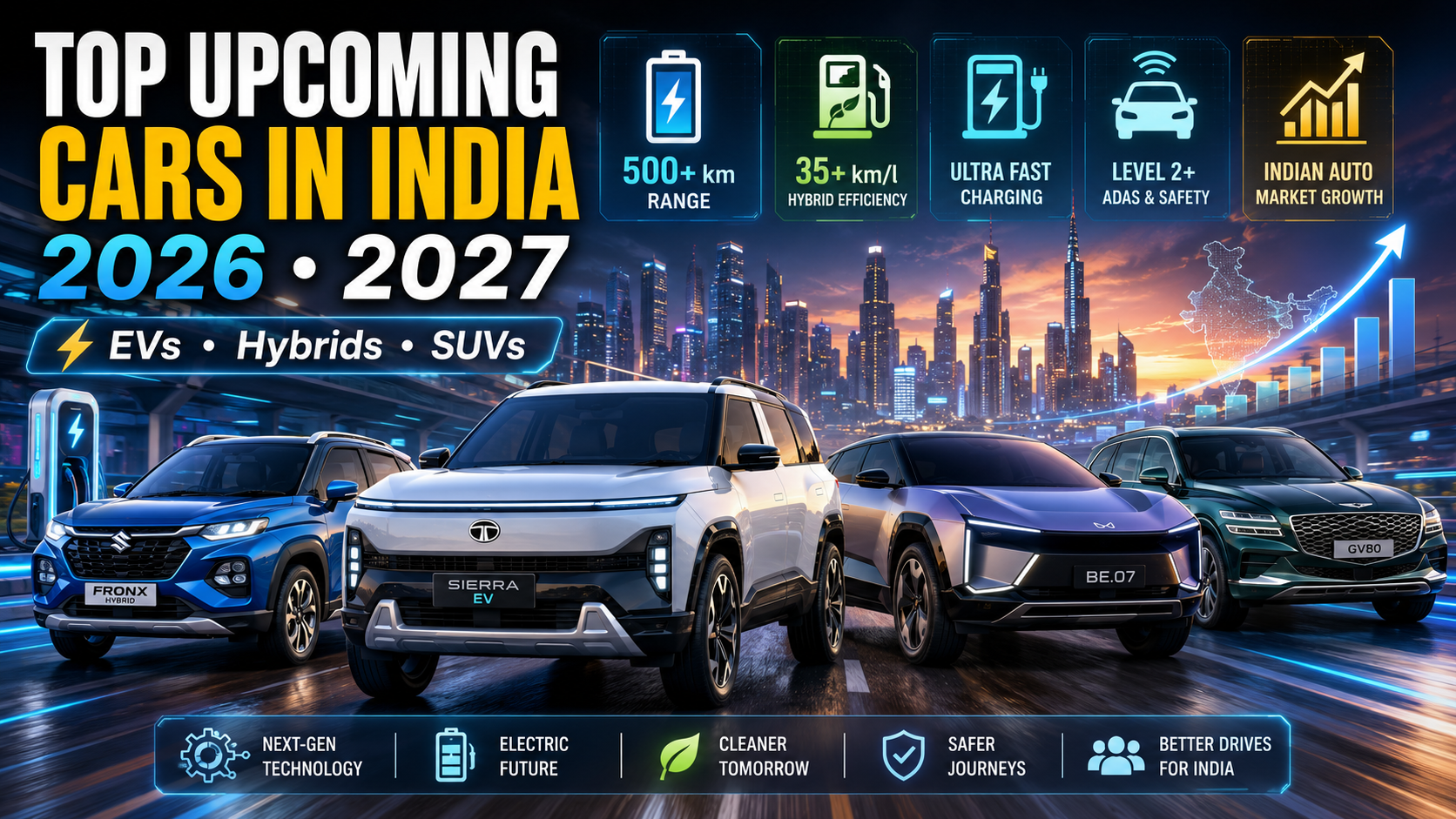
📌 9 new models planned by Maruti Suzuki, mostly SUVs and alternative powertrains 📌 26 product launches planned by Hyundai Motor India, backed by a ₹45,000 crore investment by FY2030 📌 CAFE III norms kick in from April 1, 2027, slashing the allowed fleet-average CO₂ from 113 g/km to 78.9 g/km by FY32 📌 Series Hybrids (Range Extenders) earn the highest 3.0× super credit — the same as pure EVs 📌 Tata Motors’ ARGOS platform will power a Jeep SUV destined for export to 50+ countries 📌 Genesis luxury brand officially enters India in 2027 with CKD assembly near Chennai
1. 🌐 Why 2026–2027 Is a Landmark Period for Indian Cars {#intro}
The Indian passenger vehicle market 2026–2027 is witnessing its most profound structural transformation ever. Legacy strategies are being ditched. Multi-energy platforms are in. Development cycles are getting compressed. And for the first time in automotive history, global automakers are licensing Indian-developed intellectual property for overseas use.
Here’s the scale of what’s coming:
- 🏎️ Maruti Suzuki has slashed its vehicle development cycle from 48 months to 36 months — a 25% compression — to push out nine new models skewed toward SUVs and alternative powertrains.
- 🏭 Hyundai Motor India is pumping in a staggering ₹45,000 crore investment by FY2030, planning 26 new product launches across segments.
- ⚡ Born-electric “skateboard” platforms are replacing ICE-derived EV conversions, unlocking step-function improvements in cabin space, range, and charging speed.
- 🌿 CAFE III emission norms, effective April 2027, are the single biggest catalyst pushing every OEM toward hybrids and BEVs simultaneously.
This isn’t just a refresh cycle. This is a generational reset of the Indian automobile industry.
🔗 Read more about the India EV outlook at SIAM (Society of Indian Automobile Manufacturers) and the Ministry of Heavy Industries.
2. 📜 CAFE III Norms: The Rule Change Driving Everything {#cafe}
Before diving into individual upcoming car launches in India 2026–2027, you need to understand one regulation that is forcing every automaker to rethink their entire product portfolio.
What Are CAFE III Norms? 🏛️
CAFE III (Corporate Average Fuel Efficiency III) norms are India’s strictest-ever vehicle emission standards, formulated by the Bureau of Energy Efficiency (BEE) under the Ministry of Power. They come into effect from April 1, 2027 and run through March 2032.
The mandate: automakers must reduce their fleet-average CO₂ emissions from ~113 g/km (FY27 CAFE II target) to a demanding 78.9 g/km by FY32. Additionally, the previous 3 g/km small-car relief for petrol vehicles under 909 kg is being scrapped, meaning even budget hatchback makers must innovate fast.
🎯 The Super Credit System (Volume Derogation Factor / VDF)
The most game-changing element of CAFE III is the super credit multiplier, which artificially lowers a manufacturer’s calculated fleet average when they sell low-emission vehicles.
| 🔋 Powertrain Type | ⚡ CAFE III Super Credit (VDF) | 📊 Strategic Impact |
|---|---|---|
| Battery Electric Vehicles (BEVs) | 3.0× | Each BEV sold counts as three vehicles, offsetting heavy ICE models |
| Range-Extended EVs / Series Hybrids | 3.0× | Same credit as pure BEVs — massive incentive for range extenders |
| Plug-In Hybrids (PHEVs) | 2.5× | Bridges the gap; smaller battery still earns strong credit |
| Strong Hybrids (SHEVs) | 1.6× | Key tool for mass-market OEMs transitioning from pure petrol/diesel |
💡 Key Insight: The fact that Series Hybrids earn a 3.0× multiplier — identical to pure EVs — is the single biggest reason why Maruti Suzuki and Mahindra are pivoting hard to range-extender technology right now. You get maximum regulatory credit without needing massive, expensive battery packs.
Also important: ADAS (Advanced Driver Assistance Systems) are becoming mandatory in heavy vehicles from 2026, creating a local supply chain for sensors and radars that is now trickling down to mainstream passenger cars. Expect Level 2 ADAS to be a baseline feature in virtually every new C-segment and D-segment car launching in 2026–2027.
🔗 Learn more about India’s CAFE norms at BEE India.
3. 🌿 The Hybrid Revolution: Series, PHEV & Strong Hybrid Cars India 2026 {#hybrids}
The hybrid car market in India 2026–2027 is about to explode. Here’s a detailed breakdown of the three major hybrid architectures and the key upcoming models under each.
🔁 3.1 Series Hybrid (Range Extender): Maruti Suzuki & Toyota Lead the Charge
Maruti Suzuki has made the most dramatic strategic pivot of any mass-market OEM in recent memory. They are abandoning complex parallel hybrid systems entirely in favour of an in-house Series Hybrid (Range Extender) architecture using their new Z12E 1.2-litre, three-cylinder engine.
How it works: The petrol engine has zero mechanical connection to the wheels. It runs exclusively as a generator at peak thermal efficiency, charging a compact 1.5–2 kWh battery pack, which then powers a pure electric motor that drives the car.
Why it matters for Indian car buyers:
- ✅ EV-like driving feel — instant torque, silent cabin
- ✅ Zero range anxiety — no charging infrastructure needed
- ✅ Over 35 km/l projected fuel economy
- ✅ Cheaper than traditional hybrids — no complex gearbox
- ✅ Scales down to hatchback price points
🚙 Upcoming Maruti Suzuki Hybrid Cars 2026–2027
| Model | Expected Launch | Price Range | Key Feature |
|---|---|---|---|
| Maruti Suzuki Fronx Hybrid 🥇 | Early 2027 | ₹10–15 Lakh | First series hybrid, AWD option, Level 2 ADAS |
| Baleno Hybrid | 2027 | ~₹10–14 Lakh | 60,000 units/year target |
| Swift Hybrid | 2027 | TBA | Next-gen Swift with range extender |
| Dzire Hybrid | 2027 | TBA | Compact sedan, exceptional efficiency |
| WagonR Hybrid | 2027+ | TBA | High-volume urban workhorse |
Toyota will launch a near-identical derivative under its own branding — the Toyota Urban Cruiser Taisor Hybrid — ensuring dual-brand reach by 2027. 🤝
🔗 Track updates on Maruti Suzuki India’s official website.
🔌 3.2 PHEV Disruption: MG Starlight 560 PHEV — The Diesel Killer?
While Maruti attacks the mass market, JSW MG Motor India is aiming squarely at the premium D-segment SUV buyer who currently drives a diesel.
MG Starlight 560 PHEV — launching around the festive season late 2026 — is one of the most technically impressive vehicles arriving in India this year.
Specifications at a glance:
- 🔋 Battery: 20.5 kWh Lithium Iron Phosphate (LFP)
- ⚙️ Engine: 1.5-litre naturally-aspirated petrol
- 💪 Output: 197 bhp | 230 Nm
- 🏃 0–100 km/h: 9.7 seconds
- 🔋 Pure EV range: ~125 km (covers most daily urban commutes on electricity alone)
- 🛣️ Combined range: 1,100+ km on a full tank
- 📏 Size: 4,745 mm length | 2,810 mm wheelbase (larger than Tata Safari and Mahindra XUV 7XO)
💡 Why This Matters: If you drive 40–60 km daily in a city, the Starlight 560 PHEV could run almost entirely on electricity while still offering over 1,100 km of total range for road trips. That’s the PHEV value proposition in its purest form.
Expected pricing: ₹20–30 lakh. Cabin highlights include a 12.8-inch floating touchscreen, 180-degree reclining front seats, and a panoramic sunroof.
🔀 3.3 Mahindra’s Hybrid Pivot: INGLO Meets Range Extender
Historically an EV purist, Mahindra & Mahindra has pragmatically acknowledged the need for hybrids to bridge the infrastructure gap.
- XUV 7XO Hybrid (W613): Strong hybrid using the existing W601 monocoque platform, pairing a 2.0L turbo-petrol with an electric motor. ETA: ~2027. Direct rival to upcoming Hyundai and Kia hybrid SUVs.
- XEV 9e Range Extender (W623): Built on the premium INGLO skateboard platform, this series hybrid integrates a small petrol generator (1.2L or 1.5L options under evaluation) into an architecture originally designed as pure-electric. This is genuinely complex engineering.
🗂️ Hybrid Technology Matrix: India 2026–2027
| Architecture | Key Brands | Efficiency Target | Key Models |
|---|---|---|---|
| Series Hybrid (Range Extender) | Maruti, Toyota, Mahindra | >35 km/l | Fronx Hybrid, Swift Hybrid, XEV 9e RE, Taisor Hybrid |
| Plug-In Hybrid (PHEV) | MG Motor, Mercedes-Benz, Jeep | ~125 km EV + 1,100 km total | MG Starlight 560 PHEV, S-Class PHEV |
| Strong/Parallel Hybrid | Hyundai, Kia, Honda | ~25+ km/l | Next-Gen Creta Hybrid, XUV 7XO Hybrid, Honda ZR-V Hybrid |
4. ⚡ Top Upcoming Electric Cars in India 2026–2027 {#evs}
The best electric cars launching in India 2026–2027 span an enormous price range — from sub-₹12 lakh urban commuters to ₹1.5 crore flagship luxury SUVs. Here’s your definitive guide.
🔵 4.1 Tata Motors: The EV Market Leader Doubles Down
Tata is transitioning its entire EV portfolio from legacy ICE-derived platforms to its new Gen 2 Acti.ev and Gen 3 architectures — unlocking flat floors, better weight distribution, and faster charging.
🏔️ Tata Sierra EV — India’s Most Anticipated EV of 2026
- 📅 Launch: Q2 FY2027 (July–September 2026)
- 💰 Price: ₹20–25 Lakh
- 🔋 Battery options: 55 kWh / 60 kWh / 65 kWh
- 🚀 Highlights: Dual-motor AWD option | Nostalgic wraparound rear glass | Triple-screen dashboard (12.3″ + 12.3″ + 10″) | Level 2+ ADAS | V2L and V2V charging support
- 🎯 Rival: Tata Harrier EV, Mahindra BE 6
🦁 Tata Safari EV — 7-Seat Electric Family Hauler
- 📅 Launch: Festive season 2026 (October–November)
- 💰 Price: ₹28–40 Lakh
- 🔋 Battery: ~75 kWh | Real-world range: ~450–500 km
- 🎯 Rival: MG Gloster EV, Hyundai Ioniq 9
🌟 Tata Avinya — Premium Gen 3, Clean-Sheet EV Brand
- 📅 Launch: Mid-2027
- 💰 Price: ₹40 Lakh+
- 🏆 Certified range: 500+ km | Targets entry-level European luxury EVs
🔗 Check the latest Tata EV lineup at Tata Motors India.
🟦 4.2 Hyundai: ₹45,000 Crore Bet on India-First EVs
🌿 Hyundai HE1i Compact EV — The Tata Punch EV Killer?
- 📅 Launch: Late 2026 / Early 2027
- 💰 Price: ₹12–16 Lakh (sub-4-metre SUV)
- 🔋 Battery: 42 kWh (standard) / 49 kWh (long range) | Locally sourced LFP cells from Exide 🇮🇳
- ⚡ Range: Up to 500 km certified | Supports 800V fast charging
- 📱 Dual 10.25″ displays | 360° camera | Level 2 ADAS
- 🎯 Rival: Tata Punch EV, Mahindra XUV 3XO EV
🚀 Hyundai Ioniq 9 (Flagship)
- 📅 Launch: 2027
- 🔋 Battery: 110.3 kWh | Range: 600+ km (global spec)
- 👨👩👧 3-row 7-seater flagship | Competes with Kia EV9
🔗 Explore Hyundai’s EV roadmap at Hyundai India.
🟧 4.3 Mahindra BE.07: The INGLO Platform’s Premium Crown Jewel
- 📅 Launch: CY 2027
- 💰 Price: ₹25–30 Lakh
- 📏 Size: 4,565 mm length | 2,775 mm wheelbase
- 🔋 Battery: 59 kWh / 79 kWh | Real-world range: 500+ km
- ⚡ Charging: 175 kW ultra-fast DC — 10% to 80% in just 30 minutes
- 💪 Power: 230 PS | ~400 Nm torque
- 🎨 Triple-screen dashboard | Panoramic sunroof | OTA updates
- 🎯 Rival: Tata Harrier EV, VinFast VF7
🔗 Track Mahindra EV launches at Mahindra Electric.
🔴 4.4 Honda 0 Alpha EV: Japan’s Delayed Answer to India’s EV Question
Honda is finally entering the Indian electric car market with the 0 Alpha, built on the brand-new “0 Series” — “Thin, Light, Wise” engineering philosophy.
- 📅 Launch: 2027 (road testing ongoing at Tapukara, Rajasthan)
- 💰 Price: ₹17–22 Lakh
- 🔋 Battery: 60–75 kWh | FWD single-motor
- 🎨 Low-profile stance | Vertical stacked lights | Hexagonal steering wheel | Flat-floor minimalist cabin
- 🎯 Rival: Hyundai Creta EV, Maruti e Vitara
🟢 4.5 Maruti Suzuki YMC: India’s First Mass-Market Electric MPV
Internally codenamed YMC, this is Maruti’s bold push into electric family haulers — a segment currently completely unserved in India.
- 📅 Launch: Late 2026 / Early 2027
- 💰 Price: ₹14–18 Lakh
- 🔋 Battery: 49 kWh / 61.1 kWh (shared with e Vitara)
- 📏 ~4.5 metres in length | Upright SUV-like stance | Vertical tail-lamps
- 📊 Volume target: Up to 1 lakh units/year (including exports)
- 🎯 Rival: Kia Carens EV (upcoming), Toyota Innova EV
🟣 4.6 Volkswagen Group: MEB+ Platform Arrives
🏆 Skoda Epiq (Entry-Level BEV)
- 📅 Launch: July 2027
- 💰 Price: ₹21–26 Lakh
- 🔋 55 kWh NMC battery | 440 km WLTP range | 10%–80% in 24 minutes
- 📦 475-litre boot + 25-litre frunk | V2L bidirectional charging
- 📏 4.17 metres | Drag coefficient: 0.275
👑 Skoda Peaq (Flagship 7-Seater)
- 📅 Launch: India arrival 2027 (global debut 2026)
- 💰 Price: ₹1.0–1.2 Crore
- 🔋 86 kWh | 600+ km range | 200 kW DC fast charging
- 🛋️ 1,010-litre boot (5-seat mode) | 13.6″ vertical touchscreen
📊 Key EV Launches at a Glance: India 2026–2027
| 🚗 Model | Segment | Platform | Battery / Range | Price (Ex-Showroom) |
|---|---|---|---|---|
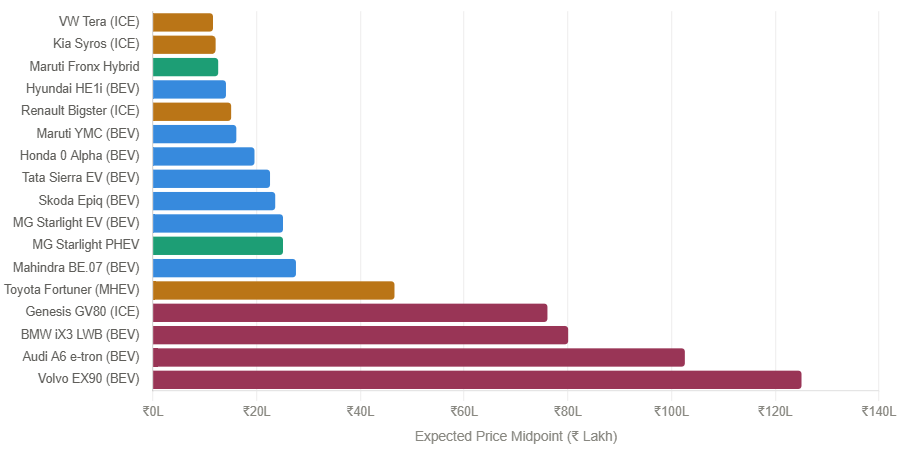
| Hyundai HE1i | Compact SUV (<4m) | E-GMP (K) | 49 kWh / ~500 km | ₹12–16 Lakh |
| Tata Sierra EV | Mid-Size SUV | Acti.ev (Gen 2) | 65 kWh / ~500 km | ₹20–25 Lakh |
| Mahindra BE.07 | Premium SUV | INGLO | 79 kWh / >500 km | ₹25–30 Lakh |
| Honda 0 Alpha | Mid-Size SUV | 0 Series | 75 kWh / TBA | ₹17–22 Lakh |
| Maruti Suzuki YMC | Electric MPV | Heartect-e | 61.1 kWh / ~500 km | ₹14–18 Lakh |
| Skoda Epiq | Compact SUV | MEB+ | 55 kWh / 440 km | ₹21–26 Lakh |
| MG Starlight EV | Premium SUV | Tianyu D | 69.2 kWh / 540 km | ₹20–30 Lakh |
5. 🛢️ Best Upcoming ICE & Mild-Hybrid Cars in India 2026–2027 {#ice}
Don’t count out internal combustion engines just yet. The upcoming petrol and diesel cars in India 2026–2027 are more technologically advanced than anything before them.
🏙️ Hyundai Creta SX3 (Next-Generation, 2027)
The Creta Gen 3 is a complete architectural overhaul — migrating from the K2 to the newer K3 platform.
- 📏 Length: ~4,500 mm | Wheelbase: ~2,690 mm
- 🖥️ Dual-screen curved panoramic floating glass panel
- 🔭 Augmented Reality Head-Up Display (windshield-projected)
- 🪑 Electric “Boss Mode” — rear passengers slide front passenger seat forward
- 🚗 Engine lineup: 1.5L NA | 1.5L Turbo | 1.5L Diesel
🏆 Kia Syros (Launched 2026)
Already in showrooms, the Kia Syros starts at ₹8.40 lakh and brings diesel-automatic affordability to the forefront.
- ⚙️ 1.0L Turbo-Petrol (120 PS, 172 Nm) | 1.5L Diesel (116 PS, 250 Nm)
- 🔌 Pure electric variant confirmed to follow
- 💰 Range: ₹8.40–15.80 Lakh
🔗 Check Syros specs at Kia India.
🏕️ Toyota Fortuner (Next-Generation, Late 2026/Early 2027)
The king of premium lifestyle SUVs in India gets a massive overhaul.
- 🔧 Updated IMV ladder-frame architecture (better ride, crash safety, stability)
- 🌿 48V mild-hybrid technology on both the 2.8L diesel and 2.7L petrol
- 🖥️ Twin 12.3-inch digital displays | Panoramic sunroof | Ventilated seats
- 🛡️ Toyota Safety Sense ADAS suite as standard
- 💰 Expected: ₹38–55 Lakh
🔗 Stay updated at Toyota India.
🇫🇷 Renault Bigster (Boreal) — September 2026
The 7-seater version of the popular Renault Duster makes its India debut.
- 📏 4.5+ metres | Targets: Mahindra XUV 7XO, MG Hector Plus
- ⛽ 1.3L Turbo-Petrol / eventual 1.2L or 1.6L Strong Hybrid variant
- ♻️ Flex-fuel compatibility
- 💰 Expected: ₹12–18 Lakh
🇩🇪 Volkswagen Tera (Sub-4-Metre SUV, Late 2026/Early 2027)
VW’s answer to the Tata Nexon and Hyundai Venue.
- 🛠️ Platform: MQB-A0-IN (same as Skoda Kylaq)
- ⚙️ 1.0L TSI (114 bhp, 178 Nm) | 6-speed manual or torque-converter auto
- 🏎️ XDS electronic differential — sharper handling
- 💰 ₹8–15 Lakh (aggressively priced)
📋 ICE / Mild-Hybrid Launch Summary: India 2026–2027
| Model | Platform | Engine | Key Update | Price |
|---|---|---|---|---|
| Hyundai Creta SX3 | K3 | 1.5L NA/Turbo/Diesel | AR-HUD, Curved displays, Boss Mode | TBA |
| Toyota Fortuner (Next-Gen) | Updated IMV | 2.8L Diesel 48V MHEV | Mild-Hybrid, Toyota Safety Sense | ₹38–55 Lakh |
| Volkswagen Tera | MQB-A0-IN | 1.0L TSI (114 bhp) | XDS, 6-AT, 18–20 km/l | ₹8–15 Lakh |
| Renault Bigster | RGMP | 1.3L Turbo + Hybrid | 7-seater, Flex-fuel | ₹12–18 Lakh |
| Kia Syros | — | 1.0L Turbo / 1.5L Diesel | Diesel-AT affordability | ₹8.40–15.80 Lakh |
6. 💸 Sub-₹10 Lakh EVs & Flex-Fuel Cars India {#budget}
The best affordable electric cars launching in India are finally here — and they’re priced for the masses.
🔋 Budget EVs Under ₹10 Lakh (India 2026–2027)
- 🇻🇳 VinFast VF3 — compact urban EV | Expected: Late 2026 | Price: ~₹7.50–10 Lakh
- 🇫🇷 Renault Kwid EV — Entry-level electric hatchback | Expected: Mid-2027 | Price: ₹8–10 Lakh
- Tata Altroz EV — Premium electric hatchback | Expected: May 2026 | Part of Tata’s expanding EV ecosystem
- Tata Punch EV Facelift — With new 6-in-1 drivetrain for improved efficiency
- Tata Tiago EV Facelift — Continued dominance in the budget EV space
🌾 Flex-Fuel Cars India: Ethanol Is the Next Big Thing
India’s push toward ethanol blending is turning into actual cars on the road:
- Maruti Suzuki WagonR Flex Fuel (E85) — runs on 85% ethanol blend | Expected: ₹6.00–7.00 Lakh | Launch: 2026–2027
- Tata Punch Flex Fuel — micro-SUV variant capable of running on high-ethanol blends
💡 Why Flex-Fuel Matters: In rural India and tier-3 cities where EV charging infrastructure is nonexistent, flex-fuel cars offer a practical, lower-emission alternative at familiar price points. Ethanol is domestically produced, reducing crude oil import dependence.
🔗 Read about India’s ethanol blending program at Ministry of Petroleum India.
7. 🌍 The Tata–Stellantis (Jeep) Alliance: India Goes Global {#alliance}
This might be the most strategically significant automotive development not just in India, but globally in 2026–2027. 🤝
Stellantis (Jeep brand) has confirmed it will use Tata Motors’ ARGOS platform (All-Terrain Ready, Omni-Energy and Geometry Scalable) to build an all-new global mid-size SUV targeted for a 2028 launch. Tata will also supply its 1.5-litre TGDi petrol engine for the vehicle.
🎯 Why This Is a Big Deal
| Factor | Detail |
|---|---|
| 💰 Capital efficiency | Developing a new platform costs $1–2 billion over 5–7 years. Licensing ARGOS eliminates that burden for Stellantis |
| 🚙 AWD requirement | Jeep mandates AWD as a brand pillar. Stellantis’ budget platforms (e.g., C-Cubed) are FWD only. ARGOS was designed AWD-native |
| 📡 E/E architecture | ARGOS has a sophisticated Ethernet-capable backbone for ADAS and connected tech — superior to older Stellantis platforms |
| 🔧 Petrol gap | Jeep India lost its 1.4L petrol engine. Tata’s BS7-compliant 1.5L TGDi fills that gap |
| 🏭 Manufacturing | Built at Tata-Stellantis JV plant in Ranjangaon |
🌟 Historic Milestone: For the first time in Indian automotive history, a Western luxury brand (Jeep) is building a global product on an Indian platform, exported to South America, Africa, the Middle East, and Asia-Pacific. India is no longer just a manufacturing hub — it is a global R&D node.
8. 👑 Upcoming Luxury Cars in India 2026–2027 {#luxury}
The premium car segment in India is going electric, going long-wheelbase, and going ultra-connected.
🏅 Genesis Enters India (2027) — Hyundai’s Luxury Brand Goes CKD
The Hyundai Motor Group’s luxury arm, Genesis, is officially debuting in India in 2027, assembled via the CKD (Completely Knocked Down) route near Chennai to navigate India’s import duty structure.
Initial launch lineup likely includes:
- Genesis GV70 (mid-size SUV)
- Genesis G80 (luxury sedan)
- Genesis GV80 (full-size flagship SUV) — 3.5L twin-turbo V6 | 380 PS | Air suspension | 27-inch OLED display | Rivals BMW X5, Audi Q7, Mercedes GLE
- 💰 GV80 Expected Price: ₹72–80 Lakh
🏎️ German Luxury: BMW, Mercedes-Benz & Audi Go Electric
BMW:
- 🔋 BMW i5 LWB (Long Wheelbase electric sedan) — Late 2026 | ~600 km real-world range | Executive rear comfort
- ⚡ BMW iX3 LWB — 650 km range | ₹75–85 Lakh | iDrive 9 software
- 🔄 X5 & X7 facelifts — Updated iDrive 9
Mercedes-Benz:
- 🔌 GLC EV LWB — Early 2027 | 650 km range | Next-gen battery
- 🔋 S-Class PHEV (Facelift) — June 2026 | ~100 km pure EV range | MB.OS infotainment | ₹1.85–2.15 Crore
Audi:
- ⚡ Audi A6 e-tron — PPE Platform | 800V rapid charging | Superior aerodynamics | ₹85 Lakh–1.2 Crore
- 🔄 Next-Gen Audi Q7 (2027) — Split headlamps | Triple-screen digital cabin | Electrified powertrains
🛡️ Other Notable Luxury Arrivals
- Volvo EX90 (September 2026) — Standard Lidar sensor technology | 7-seater | Vegan interior | ₹1.0–1.5 Crore
- Range Rover Electric — 800V architecture | 350 kW rapid charging | Peerless off-road capability (unrivalled engineering challenge)
📊 Upcoming Luxury Cars Summary: India 2026–2027
| Model | Powertrain | Key USP | Expected Price |
|---|---|---|---|
| Genesis GV80 | 3.5L Twin-Turbo V6 | 380 PS, Air Suspension, 27″ OLED | ₹72–80 Lakh |
| BMW iX3 LWB | Pure BEV | LWB, 650 km range | ₹75–85 Lakh |
| Mercedes S-Class PHEV | Plug-in Hybrid | ~100 km EV, MB.OS | ₹1.85–2.15 Crore |
| Audi A6 e-tron | Pure BEV | PPE Platform, 800V charging | ₹85 Lakh–1.2 Crore |
| Volvo EX90 | Pure BEV | Standard Lidar, 7-seat | ₹1.0–1.5 Crore |
9. ❓ FAQ: Upcoming Cars in India 2026–2027 {#faq}
Q1. What is the most exciting upcoming car in India in 2026? 🔥 The Tata Sierra EV (launching July–September 2026) and the MG Starlight 560 PHEV (festive season 2026) are the two most anticipated. The Sierra EV revives a beloved nameplate on Tata’s latest EV platform; the Starlight PHEV could genuinely replace diesel SUVs for many buyers.
Q2. What are CAFE III norms and how do they affect car buyers in India? CAFE III norms, effective April 2027, mandate that automakers achieve a fleet-average CO₂ of 78.9 g/km by FY32. For buyers, this means a massive influx of hybrid and electric cars, improved fuel efficiency across all segments, and more ADAS features becoming standard — even on mid-range models.
Q3. Is a Series Hybrid better than a Plug-in Hybrid for Indian conditions? For most Indian buyers — especially in tier-2 and tier-3 cities without EV charging infrastructure — a Series Hybrid (Range Extender) like the Maruti Fronx Hybrid makes more practical sense. It delivers EV-like efficiency (35+ km/l) without requiring any charging. PHEVs like the MG Starlight 560 are better for buyers with home charging who do both city and highway driving regularly.
Q4. Which is the best electric car under ₹15 lakh launching in India 2026–2027? The Hyundai HE1i (expected ₹12–16 lakh) is the strongest candidate, with 500 km certified range, 800V fast charging, and LFP battery cells locally sourced from Exide. The Maruti Suzuki YMC electric MPV (₹14–18 lakh) and Renault Kwid EV (₹8–10 lakh) are also strong options at different budget levels.
Q5. When is the Toyota Fortuner next generation launching in India? The next-generation Toyota Fortuner is expected in late 2026 or early 2027, featuring an updated IMV ladder-frame, 48V mild-hybrid technology, twin 12.3-inch displays, panoramic sunroof, and Toyota Safety Sense ADAS. Pricing is expected between ₹38–55 lakh.
Q6. What is the Tata–Jeep partnership about? Stellantis (Jeep brand) will use Tata Motors’ ARGOS platform and 1.5L TGDi engine to build a new global mid-size SUV, targeted for a 2028 launch. It will be manufactured at the Ranjangaon plant in India and exported to 50+ countries — cementing India’s position as a global automotive R&D and manufacturing hub.
Q7. Is Genesis coming to India? When? Yes! Genesis — Hyundai’s luxury brand — is officially entering India in 2027, with models assembled via the CKD route near Chennai to avoid high import duties. The initial lineup will likely include the GV70, G80, and flagship GV80.
Q8. What are the best hybrid cars launching in India 2027? Top hybrid car launches in India 2027 include: Maruti Suzuki Fronx Hybrid (series hybrid, ~₹10–15L), Baleno Hybrid (~₹10–14L), MG Starlight 560 PHEV (₹20–30L), Mahindra XUV 7XO Hybrid (~2027), and Next-Gen Hyundai Creta Hybrid.
10. 🏁 Final Verdict: What Should You Buy — Wait or Buy Now? {#conclusion}
The upcoming cars in India 2026–2027 represent the most transformative period in the country’s automotive history. Three macro conclusions stand out:
1️⃣ Series Hybrids Are the Near-Term Sweet Spot For the vast majority of Indian car buyers who live outside metro charging infrastructure, Maruti’s series hybrid technology — arriving in the Fronx Hybrid and cascading across its lineup — offers the best of both worlds: EV-like efficiency (35+ km/l) at accessible prices, without the charging anxiety of a pure EV.
2️⃣ Born-Electric Platforms Deliver Step-Function Improvements As Tata (Acti.ev), Mahindra (INGLO), Hyundai (E-GMP), and Skoda (MEB+) launch their born-electric SUVs, buyers choosing EVs will finally experience the flat floors, 500+ km real-world ranges, ultra-fast charging, and V2L capability that first-gen ICE-converted EVs could never deliver.
3️⃣ India Is Now a Global Automotive Technology Exporter The Tata–Stellantis (Jeep) partnership — built on Indian IP, engineered in India, exported to 50+ countries — is the most compelling proof yet that India has graduated from assembly hub to core global engineering node. This has long-term implications for jobs, investment, and India’s geopolitical standing in the global auto supply chain.
🎯 Our Recommendation: If you are planning to buy a new car in the next 6–12 months and don’t need immediate delivery, hold off and wait for the Tata Sierra EV, Hyundai HE1i, or Maruti Fronx Hybrid — each represents a generational leap over what’s currently available in their respective segments and price brackets.
🔗 Sources & Further Reading
- Bureau of Energy Efficiency (BEE) — CAFE Norms
- SIAM India — Auto Industry Data
- Tata Motors — Official EV Lineup
- Hyundai India — EV & Hybrid Models
- Maruti Suzuki India — Upcoming Cars
- Mahindra Electric — INGLO Platform
- Toyota Bharat — Model Updates
- Ministry of Heavy Industries India
- AutoCarIndia — Car Reviews & News
- Team-BHP — Indian Car Community
📅 Last Updated: June 2026 | ✍️ Written for FreeModsAPK Auto Desk | 🏷️ Tags: upcoming cars India 2026, new car launches India 2027, electric cars India, hybrid cars India, best SUV India 2026, CAFE III norms, Tata Sierra EV, Maruti Fronx Hybrid, Hyundai HE1i, Mahindra BE.07, Honda 0 Alpha, Skoda Epiq