

Table of contents
- 🚀 The Moment Everything Changed for Apple AI
- 🧠 What Are Apple Foundation Models 3? {#what-are-afm3}
- 🗂️ The Complete AFM 3 Model Family — All 5 Models Explained {#afm3-family}
- ⚡ Instruction-Following Pruning (IFP): The Breakthrough That Puts 20B Params On Your iPhone {#ifp}
- 🖥️ PT-MoE: How Apple’s Server AI Achieves Massive Scale {#pt-moe}
- 🔐 The Google & NVIDIA Alliance: Private Cloud Compute 2.0 {#pcc-alliance}
- 📊 AFM 3 Benchmark Results: Human Evaluation Data {#benchmarks}
- 🗣️ Siri AI — A Complete Rebuild from the Ground Up {#siri-ai}
- 📱 iOS 27 & iPadOS 27: Apple Intelligence Baked Into Everything {#ios27}
- 🖥️ macOS 27 Golden Gate: The End of Intel and the Liquid Glass Fix {#macos27}
- 👨💻 Xcode 27: Agentic Coding Has Arrived {#xcode27}
- 💻 Hardware Requirements: Which Devices Get Full Apple Intelligence? {#hardware}
- 📈 AAPL Stock Reaction & Market Analysis {#market}
- 👔 Tim Cook’s Legacy and the John Ternus Era {#leadership}
- ❓ Frequently Asked Questions (FAQ) {#faq}
- 🏁 Final Verdict: Is This Apple’s Biggest AI Leap Yet? {#conclusion}
🚀 The Moment Everything Changed for Apple AI
On June 8, 2026, Apple redefined what consumer artificial intelligence can look like — not through flashy demos or vague promises, but with hard engineering. At the company’s annual Worldwide Developers Conference (WWDC) 2026, Apple unveiled the third generation of Apple Foundation Models, a sweeping reimagination of how AI is built, deployed, and protected on every device in its ecosystem.
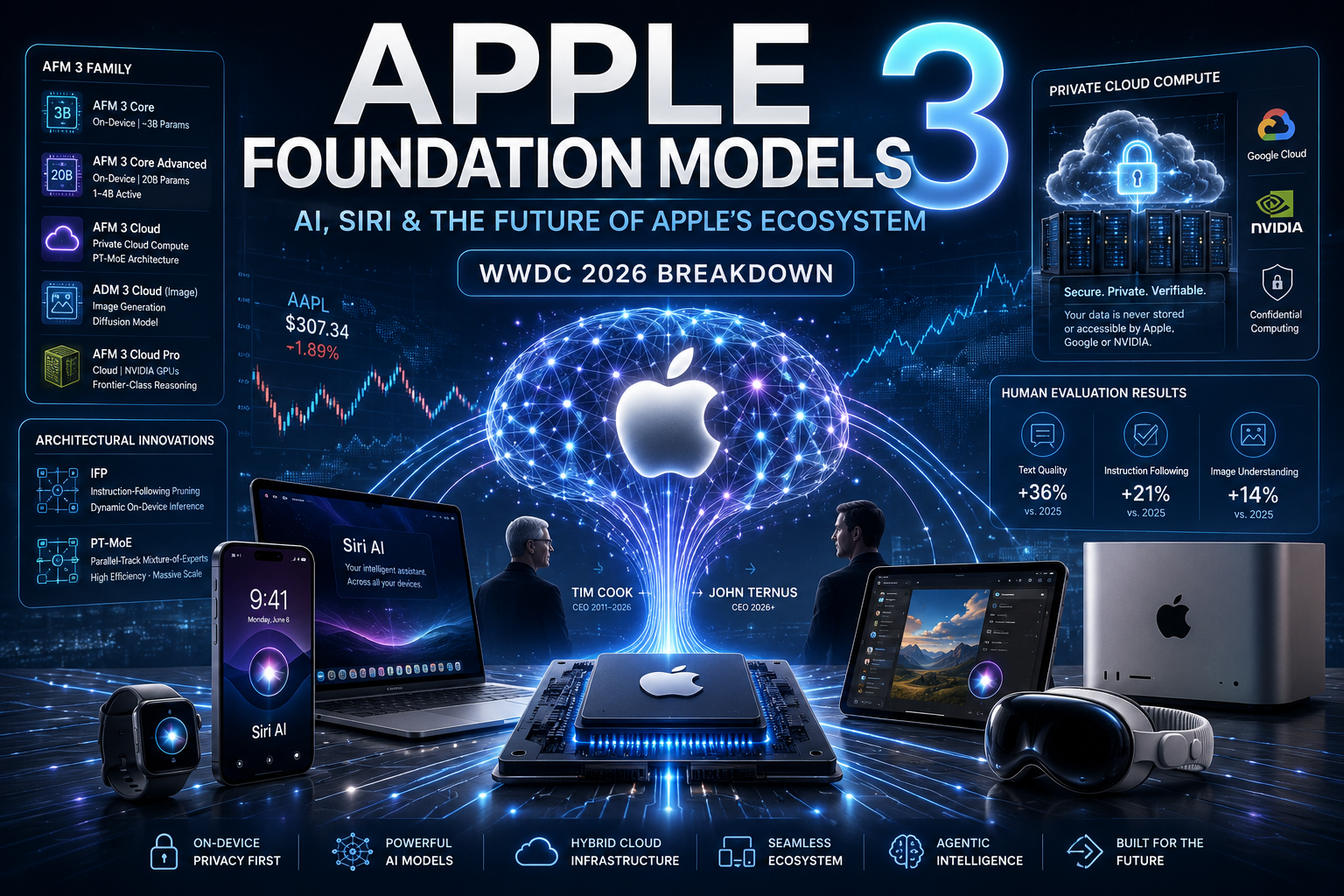
Apple Foundation Models 3, or AFM 3, isn’t just an incremental update to last year’s models. It’s a complete architectural rethink — spanning five distinct AI models, a revolutionary on-device compression technology called Instruction-Following Pruning (IFP), an upgraded Parallel-Track Mixture-of-Experts (PT-MoE) server architecture, and a landmark infrastructure alliance with Google Cloud and NVIDIA.
Layer on top of that a fully rebuilt Siri AI, a new iOS 27, macOS 27 Golden Gate, and an agentic overhaul of Xcode 27 — and you begin to understand why WWDC 2026 is already being called the most consequential Apple developer conference in over a decade.
This is everything you need to know about Apple’s AFM 3 ecosystem — from the granular math to the big market picture.
⚡ TL;DR — Key Takeaways at a Glance
- 🧠 Apple Foundation Models 3 comprises 5 distinct AI models spanning on-device to frontier-class cloud compute
- 📱 AFM 3 Core Advanced runs a 20-billion-parameter model locally on iPhone using breakthrough IFP technology — no cloud required for sensitive tasks
- ☁️ Apple’s most powerful model, AFM 3 Cloud Pro, runs on NVIDIA Blackwell B200 GPUs hosted on Google Cloud
- 🔐 All cloud processing is protected by an impenetrable cryptographic Private Cloud Compute (PCC) architecture
- 🗣️ Siri AI has been completely rebuilt from scratch as a fully contextual, cross-app agent
- 📉 AAPL stock dropped 1.89% on WWDC day due to delayed Siri AI timelines and EU/China exclusions
- 👔 Tim Cook’s final WWDC — John Ternus becomes CEO on September 1, 2026
- 💻 AFM 3 Core Advanced requires a minimum 12GB RAM — restricting top AI features to A19 Pro, M3, and M4+ hardware
🧠 What Are Apple Foundation Models 3? {#what-are-afm3}
Apple Foundation Models 3 (AFM 3) is the third generation of Apple’s proprietary family of large language and multimodal AI models, powering Apple Intelligence across iPhone, iPad, Mac, and Apple Vision Pro.
Unlike generic cloud-based AI systems from competitors, Apple’s approach to generative AI is built around a core privacy doctrine: the most personal, sensitive tasks happen entirely on your device, while only more demanding requests are elevated to Apple’s secure cloud infrastructure. This philosophy has been present since Apple Intelligence launched, but with AFM 3, the engineering has reached a fundamentally new level of sophistication.
The AFM 3 architecture is unique in the AI industry for several reasons:
- It’s not a monolith. Rather than one massive AI model, AFM 3 is a stratified family of five specialised models, each calibrated for a specific compute environment and task type.
- It solves the DRAM problem. Running a 20-billion-parameter AI model on a mobile device was previously impossible. AFM 3 changes that through a novel on-device memory management breakthrough.
- It extends privacy to third-party infrastructure. For the first time, Apple’s most powerful AI workloads run on non-Apple hardware — but with cryptographic guarantees that match Apple’s own data centres.
This is Apple’s answer to the generative AI race — not a chatbot bolted onto an operating system, but AI woven into the silicon, the software, and the infrastructure at every level.
🗂️ The Complete AFM 3 Model Family — All 5 Models Explained {#afm3-family}
Apple’s strategy of building multiple purpose-built AI models rather than a single frontier model is one of the most important architectural decisions in the AFM 3 ecosystem. The system dynamically routes every user request to the most efficient model based on task complexity, latency needs, and available hardware.
Here’s the complete breakdown of all five Apple Foundation Models 3:
| 🤖 Model | 🖥️ Runs On | 📊 Parameters | ⚙️ Architecture | 🎯 Primary Use Cases |
|---|---|---|---|---|
| AFM 3 Core | On-Device (Apple Silicon) | ~3 Billion | Dense Transformer, QAT | Everyday language tasks, basic device intelligence, text generation |
| AFM 3 Core Advanced | On-Device (Apple Silicon) | 20B (1–4B active) | Sparse + IFP pruning | Multimodal tasks, expressive voice synthesis, visual intelligence, dictation |
| AFM 3 Cloud | Private Cloud Compute (Apple Silicon servers) | Undisclosed | Parallel-Track MoE (PT-MoE) | Server-side reasoning, complex context recall, rapid text generation |
| ADM 3 Cloud (Image) | Private Cloud Compute (Apple Silicon servers) | Undisclosed | Diffusion + neural adapters | Genmoji, Image Playground, Spatial Reframing in Photos |
| AFM 3 Cloud Pro | Private Cloud Compute (NVIDIA B200 GPUs / Google Cloud) | Undisclosed (Frontier) | Gemini-distilled, PT-MoE | Agentic tool use, advanced math, hybrid reasoning workloads |
💡 Key Insight: The on-device models protect your most private data — messages, health info, photos — while the cloud models handle tasks that genuinely require frontier-class compute power. This two-tier design is what separates Apple’s AI philosophy from purely cloud-dependent competitors.
⚡ Instruction-Following Pruning (IFP): The Breakthrough That Puts 20B Params On Your iPhone {#ifp}
Without question, Instruction-Following Pruning (IFP) is the single most impressive engineering achievement announced at WWDC 2026. To understand why, you first need to understand the problem it solves.
🔴 The DRAM Bottleneck Problem
Running a 20-billion-parameter language model on a smartphone sounds impossible — and until now, it was. Traditional large language models require all model weights to be loaded into active memory (DRAM) simultaneously. A 20B parameter model, even after aggressive quantisation, demands far more RAM than any mobile device carries — let alone one that also needs to run the operating system, apps, and display rendering at the same time.
Previous approaches used smaller, static models (like AFM 3 Core’s ~3B parameters) or offloaded complex tasks to the cloud. But cloud offloading introduces latency, privacy risks, and a dependency on internet connectivity for features that should feel instant and local.
IFP is Apple’s solution.
🟢 How IFP Works — The Technical Breakdown
Instruction-Following Pruning is a dynamic, context-aware routing mechanism — not the static model compression used in previous-generation on-device AI.
Here’s the process, step by step:
- 💾 The full 20B parameter model is stored in flash memory (NAND) — the device’s larger, slower storage — rather than forcing it all into fast DRAM.
- 🔍 A lightweight “sparsity predictor” analyses the user’s incoming prompt and assigns importance scores to each layer of the neural network.
- 🎯 “Routed experts” — the specific weights relevant to the current task — are identified and selectively loaded from NAND into DRAM.
- 🧩 “Shared experts” — a core set of always-active weights — permanently reside in DRAM and handle universal language understanding.
- 🔄 The routed and shared experts combine to form a complete, high-capability model specifically tailored to the current instruction.
- ♻️ The system updates the active expert set periodically during token generation to maintain contextual accuracy.
The overhead of this dynamic weight loading? Less than 0.1 seconds per example — just 1–2% of total generation time. For the user, it’s completely invisible.
📐 Inference-Time Elasticity: Scaling from 1B to 4B Active Parameters
One of IFP’s most elegant properties is inference-time elasticity. The system doesn’t always activate the full 4B parameter ceiling — it scales based on request complexity:
- Simple dictation or autocorrect → activates closer to 1B parameters
- Complex visual reasoning or long-context analysis → scales up toward 4B active parameters
This means your battery isn’t draining at maximum load for every text message, while still delivering frontier-quality intelligence when genuinely needed.
🔒 Why This Matters for Privacy: Because IFP keeps computation on-device, your most sensitive requests — reading your messages, understanding your photos, synthesising your voice — never leave your iPhone. No cloud call. No data exposure. This is Apple’s on-device AI philosophy executed at its highest level.
🖥️ PT-MoE: How Apple’s Server AI Achieves Massive Scale {#pt-moe}
When a task exceeds the capabilities of even the powerful on-device models, Apple’s operating system routes the request to Private Cloud Compute — and that’s where the Parallel-Track Mixture-of-Experts (PT-MoE) architecture takes over.
What Is PT-MoE?
The Mixture-of-Experts (MoE) approach to AI architecture routes different parts of a computation to specialised sub-networks (“experts”) rather than processing everything through the same dense network. Apple’s PT-MoE implementation elevates this further with multiple simultaneous parallel processing tracks — one focused on local syntactic features, another on global semantic context — whose outputs are synthesised through interleaved global-local attention.
At the mathematical core, PT-MoE uses a shared projection matrix alongside expert-specific low-rank factors, drastically reducing trainable parameters while maintaining massive representational capacity. The result in production: up to 87.5% reduction in synchronisation overhead compared to traditional tensor parallelism — enabling the sub-second response times that consumer applications demand.
🖼️ ADM 3 Cloud: Apple’s Dedicated Image AI
Running alongside the text models on Apple’s server infrastructure is ADM 3 Cloud — a diffusion-based image generation and editing model with specialised neural adapters for specific downstream tasks:
- 🎨 Image Playground — creative image generation from text prompts
- 😀 Genmoji — custom AI-generated emoji based on descriptions
- 📷 Spatial Reframing in Photos — AI-powered composition and perspective adjustment after the shot
- ✏️ Touch-based editing — circle or brush an object to remove, resize, or replace it
🔐 The Google & NVIDIA Alliance: Private Cloud Compute 2.0 {#pcc-alliance}
This is the announcement that raised the most eyebrows at WWDC 2026: Apple’s AFM 3 Cloud Pro — its most powerful AI model, designed for agentic tasks and complex reasoning — runs on NVIDIA Blackwell B200 GPUs hosted within Google Cloud data centres.
For a company historically committed to total infrastructural self-sufficiency, this represents a profound strategic shift. Apple has acknowledged it openly: the raw compute required for frontier-class AI simply exceeds what Apple-owned, Apple-Silicon-based infrastructure can currently deliver at scale.
🛡️ How Apple Maintains Privacy on Third-Party Hardware
Extending the Private Cloud Compute trust model to non-Apple hardware required building an entirely new layered security architecture:
- NVIDIA Confidential Computing encrypts data actively being processed inside GPU memory — so even NVIDIA cannot see the computation
- Intel CPUs with Trust Domain Extensions (TDX) provide hardware-level isolation
- Google’s Titan security chips secure the physical hardware
- Cryptographic append-only ledger of all participating Google Cloud hardware, verifiable by Apple
- Ephemeral shared inference software with ultra-short time-to-live (TTL) values — no persistent state
- Isolated confidential virtual machines hold attested cryptographic keys
The fundamental guarantee remains unchanged: personal user data is never stored, logged, or accessible by Apple, Google, or NVIDIA. Security researchers receive public tooling and live access to PCC nodes in research mode through the Apple Security Bounty Program for independent auditing.
🤝 The Strategic Picture: Google and NVIDIA supply raw compute. Apple owns the software stack, the attestation chain, and the cryptographic guarantees. It’s a pragmatic industrial alliance — and one that signals Apple’s recognition that winning the AI era requires partnerships, not just pristine vertical integration.
📊 AFM 3 Benchmark Results: Human Evaluation Data {#benchmarks}
Apple released extensive human preference evaluation data comparing AFM 3 against the 2025 baseline models. Rather than relying solely on automated benchmarks (which can be gamed), Apple’s methodology uses trained human graders evaluating responses on dimensions including Instruction Following, Truthfulness, Presentation, and Image Understanding.
📱 On-Device Model Performance (AFM 3 Core vs. 2025 Baseline)
Human evaluators compared responses across global regions in side-by-side testing:
| 🌍 Region / Locale | ✅ AFM 3 Core Preferred | 🤝 Tie | ❌ 2025 Baseline Preferred |
|---|---|---|---|
| English (Global) | 38.0% | 39.0% | 23.0% |
| PFIGSCJK (Pan-Asian + European) | 43.0% | 31.0% | 26.0% |
| DNNSTV | 42.4% | 28.3% | 29.3% |
| AFIHHMPRTU | 55.5% | 26.2% | 18.3% |
For Image Understanding specifically, evaluators preferred AFM 3 Core on 26.6% of prompts vs. just 16.8% for the 2025 baseline — meaning when ties are excluded, the new model wins over 61% of the time.
☁️ Server-Side Model Performance (AFM 3 Cloud vs. 2025 Server)
The performance gains are even more dramatic for the server-side Apple Foundation Models:
| 🌍 Region / Locale | ✅ AFM 3 Cloud Preferred | 🤝 Tie | ❌ 2025 Server Preferred |
|---|---|---|---|
| English (Global) | 56.0% | 33.0% | 11.0% |
| PFIGSCJK | 68.3% | 24.8% | 6.9% |
| DNNSTV | 68.6% | 22.8% | 8.6% |
| AFIHHMPRTU | 66.6% | 23.1% | 10.3% |
Additional headline metrics for AFM 3 Cloud in single-sided evaluation:
- 📈 +36% relative improvement in overall response satisfaction
- 📈 +21% relative improvement in instruction following
- 🖼️ Image Understanding preference: 37.8% (vs. just 9.6% for 2025 baseline)
AFM 3 Cloud Pro then adds another layer on top:
- 📈 +10% improvement in overall text response satisfaction over AFM 3 Cloud
- 🖼️ +14% improvement in image understanding
- 🔢 +14% improvement in mathematical reasoning tasks
🎙️ Voice & Dictation: The MOS Score Leap
The rebuilt Text-to-Speech system powered by AFM 3 Core Advanced shows exceptional improvement on the industry-standard 5-point Mean Opinion Score (MOS) scale:
| 🔊 Voice Type | 🔴 Current Production TTS | 🟢 AFM 3 Core Advanced |
|---|---|---|
| General Voice | 3.87 | 4.15 (+0.28) |
| Conversational Voice | 3.82 | 4.24 (+0.42) |
⚠️ Context: In audio engineering, a 0.1 MOS increase is considered clearly noticeable to users. The +0.42 delta in conversational voice — the voice you hear reading notifications, giving directions, or reading Messages — represents a genuinely transformative quality improvement that effectively eliminates the “robotic” quality that has long plagued digital assistants.
For dictation, the new system dominates across all evaluation dimensions:
| 📝 Quality Dimension | ✅ AFM 3 Preferred | 🤝 Tie | ❌ Previous Preferred |
|---|---|---|---|
| Overall Quality | 44.7% | 37.7% | 17.6% |
| Punctuation Accuracy | 50.2% | 37.4% | 12.4% |
| Meaning Capture | 23.0% | 63.0% | 13.9% |
| Disfluency Handling | 22.3% | 67.2% | 10.6% |
🗣️ Siri AI — A Complete Rebuild from the Ground Up {#siri-ai}
Years of incremental patches couldn’t fix a fundamentally flawed architecture. With Siri AI — Apple’s rebranded, fully rebuilt digital assistant — the company has finally started over.
What’s New in Siri AI?
Multi-turn contextual memory — Siri AI maintains conversational context across multiple exchanges and interactions. You no longer have to restart from scratch with every follow-up question.
Deep cross-app intelligence — Siri AI can securely search across Mail, Messages, Calendar, Photos, and third-party apps to execute complex multi-step workflows. A single natural-language prompt like “Find my flight confirmation, check the weather at my destination, add the trip to my calendar, and text the details to my partner” is now a one-shot operation.
Visual Intelligence & On-Screen Awareness — Siri AI analyses your active screen in real-time. It can extract an address from a webpage, split a restaurant bill shown in a photo using Apple Cash, or identify products you’re looking at. On Apple Vision Pro, it extends to your physical environment — ask Siri what something is, just by looking at it.
Standalone Siri AI app — A dedicated, full-screen Siri application syncs conversational history across all iCloud devices. Start a complex research session on iPhone, resume it on Mac.
Personalised writing tone — Siri AI analyses your historical communication patterns with specific contacts to match your typical tone, vocabulary, and punctuation in AI-drafted messages and emails.
💬 One Caveat: Siri AI’s full feature set will not launch with iOS 27 in September. It enters developer beta “later this year,” meaning the polished consumer version likely won’t arrive until early-to-mid 2027. This staggered timeline was the primary driver of Apple’s stock sell-off on WWDC day.
📱 iOS 27 & iPadOS 27: Apple Intelligence Baked Into Everything {#ios27}
iOS 27 is the most AI-saturated operating system update in Apple’s history. Apple Intelligence isn’t a feature in iOS 27 — it’s the operating system’s nervous system.
✨ Notable iOS 27 AI Features
🔔 Safari “Notify Me” — Safari autonomously monitors specific webpages and alerts you when content changes — ideal for tracking price drops, restock notifications, or breaking news updates.
🗂️ Automatic Tab Grouping — Safari categorises your open tabs by topic in the background, keeping browsing sessions organised without manual effort.
🔧 Natural Language Browser Extensions — Describe the functionality you want, and Safari generates a custom browser extension without requiring any coding knowledge.
📧 AI-Powered Mail & Messages — System-wide writing tools draft emails from scratch, summarise lengthy documents, and proofread text across virtually every third-party app on the device.
🎧 Custom EQ for AirPods — AirPods Pro users finally get granular audio control — adjustable lows, mids, and highs through a real-time waveform visualisation interface.
👶 Enhanced Parental Controls — The new “Ask to Browse” feature requires child accounts to request parental permission before accessing unapproved websites. Screen Time now supports category-based daily time allowances (Entertainment, Social Media, etc.). Communication Safety now proactively blurs and blocks violent or graphic imagery system-wide.
🖥️ macOS 27 Golden Gate: The End of Intel and the Liquid Glass Fix {#macos27}
macOS 27 Golden Gate marks two historic milestones: the official end of Intel Mac support, and the resolution of the controversial UI design introduced in last year’s macOS Tahoe.
🔚 End of Intel Support
Golden Gate runs exclusively on Apple Silicon — M-series Macs and the forthcoming A18 Pro-powered MacBook Neo. This closes the Intel chapter of Apple’s Mac history definitively, consolidating the platform around the unified memory architecture that makes local AI inference so powerful.
🪟 Fixing Liquid Glass
The “Liquid Glass” translucent design language from macOS Tahoe was widely criticised for degrading text legibility and creating glare. In Golden Gate, Apple introduces a system-wide transparency slider — users can dial the interface from fully transparent to completely opaque, restoring readability without abandoning the design aesthetic.
Additional interface refinements include:
- Toolbars unified across windows
- Sidebars extending to window edges with solid colour fills
- App icons redesigned with layered refractive artwork for sharper visuals
⚡ Under the Hood: Performance Improvements
- 🚀 Apps launch up to 30% faster via a rewritten CPU scheduler
- 📡 AirDrop transfers complete up to 80% faster
- 🔍 Near-instant content indexing for Spotlight, Photos, and Mail — new files are searchable in seconds, not after a batch processing delay
- 💬 Spotlight becomes the primary Siri AI access point on Mac, featuring a new “Search or Ask” interface
👨💻 Xcode 27: Agentic Coding Has Arrived {#xcode27}
For developers, Xcode 27 represents an equally seismic shift. Apple’s IDE has taken a bold leap into agentic AI coding — and in a significant reversal of Apple’s historically closed-ecosystem philosophy, it now openly supports third-party AI models.
🤖 Agentic Coding Features
Multi-turn AI planning — Xcode 27 agents engage in interactive, multi-step conversations to plan and execute code changes. The AI can write tests, run them, analyse failures, revise code, and verify visual layout changes using SwiftUI previews — all autonomously within sandboxed Playground environments.
Dual-pane canvas — A split view renders Markdown planning notes alongside live code diffs in real-time.
Model freedom — Alongside Apple Foundation Models, Xcode 27 now supports models from Anthropic, Google, and OpenAI via the new Model Context Protocol (MCP) integration.
Device Hub — A unified device management panel replaces previously fragmented simulator and provisioning tools.
Third-party plugin ecosystem — Platforms like GitHub and Figma can now install directly into Xcode 27 via the Agent Client Protocol, deeply integrating Apple’s development environment with the broader software engineering ecosystem.
📦 Housekeeping Updates
- Restricted to Apple Silicon only
- 30% reduction in application file size
- Fully customisable toolbar and global theme system
💻 Hardware Requirements: Which Devices Get Full Apple Intelligence? {#hardware}
AFM 3 Core Advanced — the on-device 20B parameter model — is computationally demanding. Apple has set a firm hardware floor:
✅ Supported Hardware (Full AFM 3 Core Advanced Access)
| 📱 Device | 🔧 Chip Requirement |
|---|---|
| iPhone 17 Pro / iPhone 17 Pro Max | A19 Pro (12GB RAM minimum) |
| iPhone Air (rumoured) | A19 Pro (12GB RAM) |
| iPad with M4 or later | M4 chip (12GB+ RAM) |
| Mac with M3 or later | M3 chip (12GB+ RAM) |
❌ Limited to AFM 3 Core Only (or Cloud Offload)
| 📱 Device | ⚠️ Limitation |
|---|---|
| Standard iPhone 17 (8GB RAM) | Only AFM 3 Core (~3B params) or cloud routing |
| Older iPads (M2 and below) | Cloud-dependent for advanced AI features |
| Intel Macs | No macOS 27 support at all |
🖥️ The Mac Studio Surge and M5 Ultra Anticipation
Immediately post-WWDC, Mac Studio and high-end Mac Mini configurations experienced global inventory shortages driven by AI developer demand. Apple’s Apple Silicon unified memory architecture — where CPU, GPU, and NPU share the same high-bandwidth memory pool — makes it uniquely efficient for loading large open-source AI models locally, a task that would otherwise require multiple enterprise NVIDIA GPUs on a traditional PC.
The anticipated M5 Ultra — expected for Q4 2026 — is expected to use TSMC’s N3P 3nm manufacturing process with advanced SoIC-mH packaging for unprecedented chip integration. With a rumoured 512GB unified memory ceiling and a 36-core CPU, it’s being positioned explicitly as a local AI workstation capable of running massive agentic models entirely offline.
📈 AAPL Stock Reaction & Market Analysis {#market}
The AAPL stock reaction on WWDC day told a nuanced story about investor expectations versus technical reality.
📅 The Timeline
- May 2026: AAPL surges +15%, adding ~$500B in market cap on AI anticipation, pushing valuation toward $4.5–4.6 trillion
- Intraday WWDC high: AAPL touches $317.09 (Fibonacci 0.0 resistance), RSI at 72.93 (near-overbought)
- WWDC close: AAPL finishes down 1.89% at ~$307.34 — a 4.8% intraday reversal from the peak
🔴 Why the Sell-Off?
Two primary concerns drove institutional and retail selling:
1️⃣ Siri AI Timeline Uncertainty The headline feature — the fully rebuilt Siri AI — will not launch with iOS 27 in September. It enters developer beta “later this year,” with analysts at Deepwater Asset Management noting that investors had priced in a September launch. The consumer-ready version is now expected in early-to-mid 2027.
2️⃣ EU and China Exclusions Apple Intelligence and Siri AI will be excluded from the European Union (Digital Markets Act compliance issues) and China (pending regional AI model approvals) at launch — removing two of Apple’s largest markets from the immediate AI upgrade cycle.
🟢 Long-Term Bullish Case
Despite the short-term volatility, institutional sentiment remains broadly positive:
- Morgan Stanley maintains a bull-case price target of $440, citing Apple’s secure on-device AI narrative
- The 12GB RAM hardware floor is expected to catalyse an iPhone upgrade supercycle over the next 24–36 months as hundreds of millions of users on legacy hardware seek access to premium AI features
- The AFM 3 ecosystem lock-in — tightly integrated with Apple Silicon, iOS, and iCloud — creates lasting competitive differentiation
👔 Tim Cook’s Legacy and the John Ternus Era {#leadership}
WWDC 2026 carried weight far beyond software features. It was Tim Cook’s final WWDC keynote as CEO — a poignant close to a transformative 15-year tenure.
Tim Cook: By the Numbers
- 📅 Became CEO: August 24, 2011
- 📅 Transitioning to Executive Chairman: September 1, 2026
- 💰 Market cap growth under Cook: +$4 trillion+
- 🔄 Strategic legacy: Transformed Apple from a hardware manufacturer into a diversified services ecosystem — services revenue now rivals hardware in profitability
Cook’s final keynote was framed around legacy — delivering a privacy-first AI architecture as his final act, and passing a platform at the frontier of a new computing paradigm to his successor.
John Ternus: The New Chapter
John Ternus, a 25-year Apple veteran and the architect of the Mac’s Apple Silicon transition as Senior Vice President of Hardware Engineering, was highly visible at WWDC — mingling with student developers at Apple Park in a calculated display of approachability and continuity.
Ternus inherits three immediate priorities:
- 🚀 Execute Siri AI’s flawless public rollout
- 📦 Resolve Mac Studio supply chain constraints
- 🌍 Navigate EU and China regulatory landscapes for global Apple Intelligence deployment
As noted by The Verge and 9to5Mac, investor confidence in the Ternus era will be measured almost entirely by how cleanly AFM 3 and Siri AI roll out to consumers over the next 12 months.
❓ Frequently Asked Questions (FAQ) {#faq}
Q: What is the difference between AFM 3 Core and AFM 3 Core Advanced? AFM 3 Core is a dense ~3 billion parameter model that runs on all supported Apple Intelligence devices including the base iPhone 17. AFM 3 Core Advanced is the larger 20 billion parameter model with IFP that activates 1–4B parameters dynamically — it requires a minimum of 12GB RAM and is restricted to A19 Pro, M4 iPads, and M3+ Macs.
Q: Does Apple Foundation Models 3 require an internet connection? AFM 3 Core and AFM 3 Core Advanced operate entirely on-device with no internet required. The AFM 3 Cloud, ADM 3 Cloud, and AFM 3 Cloud Pro models require an internet connection to communicate with Private Cloud Compute servers.
Q: Is Apple Intelligence available in the EU or China? Not at launch. Due to Digital Markets Act (DMA) regulatory requirements, Apple Intelligence and Siri AI will not be available in the European Union at the time of iOS 27’s release. China availability is also pending regional AI model approvals.
Q: Can I use ChatGPT or Gemini through Siri AI? Yes. Siri AI retains the ChatGPT integration introduced in previous versions of Apple Intelligence. Based on WWDC 2026 disclosures, the system also routes certain requests to AFM 3 Cloud Pro — which is distilled using Google Gemini outputs — though this is transparent to the end user.
Q: Which iPhone supports full Apple Intelligence in iOS 27? The iPhone 17 Pro and iPhone 17 Pro Max (with A19 Pro and 12GB RAM) support the full AFM 3 Core Advanced experience. The standard iPhone 17 (8GB RAM) is limited to AFM 3 Core and cloud-offloaded requests.
Q: What is the IFP technology in Apple’s on-device AI? Instruction-Following Pruning (IFP) is Apple’s proprietary dynamic weight-loading mechanism that allows a 20-billion-parameter AI model to run within the limited DRAM of a mobile device. Rather than loading all parameters at once, IFP selectively loads only the model weights (experts) most relevant to the current user instruction, pulling them from flash storage on demand.
Q: When will Siri AI be available to consumers? Siri AI enters developer beta in late 2026. The full consumer-ready version is expected to reach general availability in early-to-mid 2027. A limited set of Siri AI features will be available in iOS 27 at launch in September 2026.
Q: What is Apple’s Private Cloud Compute? Private Cloud Compute (PCC) is Apple’s secure cloud AI infrastructure. It processes user requests in isolated, cryptographically attested environments where Apple has no access to the underlying data. With AFM 3, PCC has expanded to include NVIDIA GPU servers on Google Cloud for the frontier-class AFM 3 Cloud Pro model, while maintaining the same privacy guarantees through confidential computing technology.
🏁 Final Verdict: Is This Apple’s Biggest AI Leap Yet? {#conclusion}
Yes — unequivocally. Apple Foundation Models 3 represents the most significant architectural evolution in Apple’s AI history, and arguably one of the most technically sophisticated on-device AI deployments the industry has ever attempted.
By solving the DRAM bottleneck with IFP, Apple has achieved what competitors said was impossible: a genuinely powerful, natively multimodal, 20-billion-parameter AI model that runs privately on your iPhone. By extending Private Cloud Compute to frontier-class infrastructure through its Google–NVIDIA alliance — while maintaining cryptographic guarantees — Apple has proven that privacy and capability are not mutually exclusive even at the highest echelons of AI performance.
The short-term headwinds are real: Siri AI’s delayed timeline, EU and China exclusions, and inventory shortages in high-demand Mac configurations will create friction in the near term. But the long-term architecture is enormously compelling.
The hardware requirements around AFM 3 Core Advanced will drive the biggest iPhone upgrade cycle in years. The depth of AI integration in iOS 27 and macOS 27 Golden Gate will make older devices feel increasingly limited. And the agentic capabilities baked into Xcode 27 will reshape how Apple’s developer ecosystem builds apps for the next generation.
As John Ternus steps into the CEO role in September 2026, he inherits one of the most technically ambitious AI roadmaps in the industry. The plumbing is in place. The execution is what’s left.
📬 Stay Updated on Apple AI News Follow the latest developments in Apple Intelligence, iOS 27, and AFM 3 from trusted sources including MacRumors, 9to5Mac, AppleInsider, and TechCrunch’s Apple coverage. For developer-focused insights, bookmark Apple’s Developer portal.
Sources: Apple Newsroom | Apple Security Research | Apple Developer | NVIDIA B200 GPU | Google Cloud | TSMC Technology | Yahoo Finance AAPL | Morgan Stanley Research | Deepwater Asset Management | Anthropic | OpenAI | GitHub MCP | Figma