

Table of contents
- Oil Prices Fall Below $90 After Trump Announces End of Iran War
- What Did Donald Trump Announce?
- Why Oil Prices Fall Below $90 Matters
- The Strait of Hormuz: The World’s Most Important Oil Chokepoint
- Understanding the Oil Market Sell-Off
- Could Iranian Oil Return to Global Markets?
- Impact on India: Major Benefits Ahead
- Winners and Losers From Falling Oil Prices
- What Happens Next?
- FAQ: Oil Prices Fall Below $90
- Final Analysis
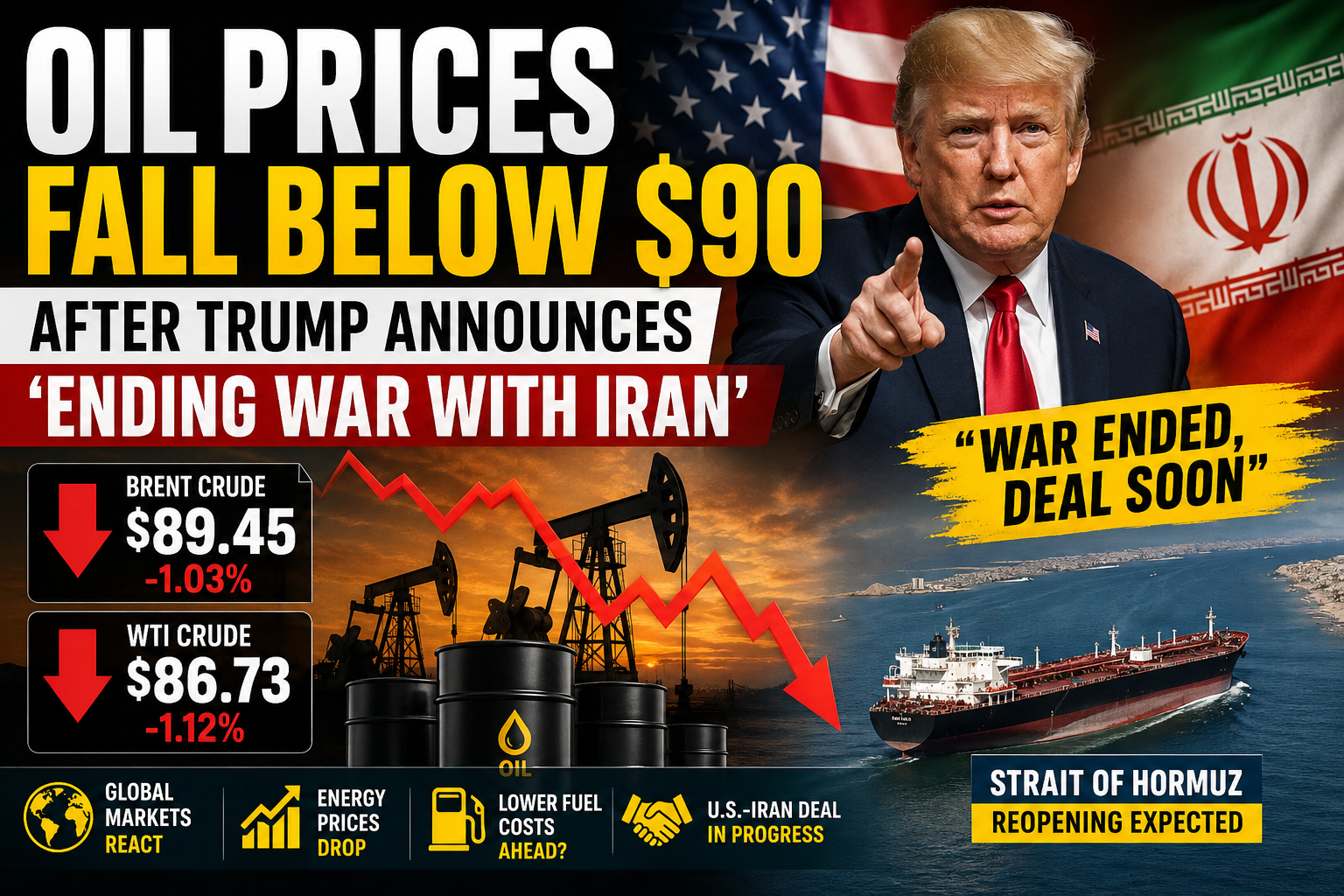
Oil Prices Fall Below $90 After Trump Announces End of Iran War
Global energy markets witnessed a dramatic reversal as oil prices fell below $90 per barrel, sending shockwaves across commodity markets, stock exchanges, and economic forecasting models worldwide.
Both Brent crude oil and WTI crude oil declined sharply after U.S. President Donald Trump announced that Washington had reached a framework agreement with Iran and declared that the conflict had effectively ended.
The announcement triggered an immediate sell-off in crude futures as investors began pricing in the possibility of restored oil supplies, a reopening of the Strait of Hormuz, and reduced geopolitical risks in the Middle East.
At the time of reporting:
📉 Brent Crude: $89.45 per barrel
📉 WTI Crude: $86.73 per barrel
The sudden decline marks one of the most significant energy market developments of 2026 and could have far-reaching implications for fuel prices, inflation, stock markets, shipping industries, and global economic growth.
🔥 Key Highlights
✅ Oil prices fall below $90 for the first time in weeks
✅ Brent crude drops over 1%
✅ WTI crude declines below $87
✅ Trump claims U.S.-Iran conflict is ending
✅ Strait of Hormuz reopening expected
✅ Global shipping and energy markets rally
✅ Inflation concerns ease worldwide
✅ India, Europe, and Asia expected to benefit from lower oil costs
What Did Donald Trump Announce?
Speaking during a political rally supporting Georgia Lieutenant Governor Burt Jones, President Donald Trump made a surprise declaration that immediately influenced global markets.
According to Trump:
“I don’t know if you heard, but we ended the war with Iran today.”
The U.S. President further stated that an official agreement could be finalized within days and suggested that shipping through the strategically vital Strait of Hormuz would soon resume normal operations.
The comments followed reports that Washington had suspended planned military strikes after diplomatic discussions with Tehran showed progress.
However, Iranian officials have not fully confirmed the agreement, creating uncertainty regarding the final outcome of negotiations.
Why Oil Prices Fall Below $90 Matters
The focus keyword dominating financial headlines today is simple:
Oil Prices Fall Below $90
This level is psychologically important because traders view $90 per barrel as a major support threshold.
When oil trades above $100:
❌ Inflation rises
❌ Transportation costs increase
❌ Manufacturing expenses climb
❌ Consumer spending weakens
❌ Central banks face pressure
When oil prices fall below $90:
✅ Economic optimism improves
✅ Energy costs decline
✅ Airline profits rise
✅ Shipping costs decrease
✅ Inflation expectations ease
This explains why equity markets, airline stocks, and transportation companies reacted positively to the news.
The Strait of Hormuz: The World’s Most Important Oil Chokepoint
No discussion about oil prices can ignore the Strait of Hormuz.
The narrow waterway connects the Persian Gulf to international shipping lanes and carries approximately:
📊 20% of global oil supply
📊 25% of seaborne crude exports
📊 Major LNG shipments to Asia and Europe
For months, concerns surrounding the Strait of Hormuz created a massive geopolitical premium in crude oil prices.
When Iran restricted maritime traffic and threatened vessels passing through the route, markets feared a global energy crisis.
As a result:
- Brent crude surged above $100
- WTI crude experienced extreme volatility
- Shipping insurance premiums skyrocketed
- Energy-importing nations faced rising costs
Now, investors are betting that those risks may soon disappear.
Understanding the Oil Market Sell-Off
The recent decline in oil prices is not necessarily about current supply.
Instead, it reflects changing expectations.
Energy traders price oil based on:
Physical Supply
- OPEC production
- U.S. shale output
- Global inventories
- Refinery demand
Risk Premium
- Wars
- Terror threats
- Sanctions
- Maritime disruptions
- Political instability
The Middle East conflict created one of the largest geopolitical premiums in years.
Now that peace appears possible, traders are rapidly removing that premium.
This is the primary reason oil prices have fallen so quickly.
Could Iranian Oil Return to Global Markets?
One of the biggest questions facing energy investors is how much Iranian oil could re-enter global supply chains.
If sanctions are eased and export restrictions are reduced, analysts estimate Iran could gradually increase exports by hundreds of thousands of barrels per day.
Potential consequences include:
🔹 Greater global supply
🔹 Lower crude prices
🔹 Reduced market volatility
🔹 Increased competition among exporters
🔹 Additional pressure on OPEC+ strategies
The return of Iranian barrels would significantly reshape energy market dynamics throughout 2026 and 2027.
Impact on India: Major Benefits Ahead
India remains one of the world’s largest crude oil importers.
As a result, falling oil prices directly benefit the Indian economy.
Lower Fuel Prices
Cheaper crude often leads to reduced petrol and diesel costs.
Reduced Inflation
Transportation costs influence nearly every sector of the economy.
Improved Fiscal Position
Lower import bills strengthen India’s external accounts.
Stronger Economic Growth
Businesses benefit from reduced operational expenses.
Lower Logistics Costs
E-commerce, manufacturing, and transportation sectors gain competitive advantages.
For India, oil prices below $90 could become a significant macroeconomic tailwind.
Winners and Losers From Falling Oil Prices
🏆 Potential Winners
Airlines
Lower jet fuel costs improve profitability.
Logistics Companies
Reduced transportation expenses increase margins.
Consumers
Lower fuel prices support household spending.
Emerging Markets
Countries dependent on imported energy benefit substantially.
Manufacturing Businesses
Production costs decrease.
⚠️ Potential Losers
Oil Exporting Nations
Revenue declines as prices fall.
Energy Producers
Profit margins shrink.
High-Cost Shale Operators
Some production becomes less economical.
Commodity Traders
Volatility may reduce speculative opportunities.
What Happens Next?
Scenario 1: Peace Agreement Signed
Probability: High
Expected Brent Range:
$80–$95
Expected Outcome:
✅ Hormuz reopens
✅ Oil supply normalizes
✅ Market volatility declines
✅ Global inflation pressures ease
Scenario 2: Negotiations Collapse
Probability: Moderate
Expected Brent Range:
$110–$130
Expected Outcome:
❌ Shipping disruptions continue
❌ Military tensions escalate
❌ Oil supply risks return
❌ Global inflation accelerates
Scenario 3: Extended Diplomatic Process
Probability: Medium
Expected Brent Range:
$90–$105
Expected Outcome:
⚠️ Uncertainty remains
⚠️ Markets trade sideways
⚠️ Investors await confirmation
FAQ: Oil Prices Fall Below $90
Why did oil prices fall below $90?
Oil prices fell after President Trump announced progress toward ending the conflict with Iran, raising hopes that global oil supplies could normalize and the Strait of Hormuz could reopen.
What is the current Brent crude price?
Brent crude recently traded around $89.45 per barrel.
Why is the Strait of Hormuz important?
Approximately 20% of global oil passes through the Strait of Hormuz, making it one of the most important energy corridors in the world.
Will petrol prices decrease?
If crude prices remain below $90 for an extended period, consumers could eventually see lower fuel costs, depending on local taxes and currency movements.
How does lower oil affect inflation?
Lower energy prices reduce transportation and manufacturing costs, helping to ease inflationary pressures.
Final Analysis
The headline dominating global financial markets today is clear:
Oil Prices Fall Below $90
The decline represents far more than a routine commodity correction. It reflects a fundamental reassessment of geopolitical risk following signs of a potential breakthrough between the United States and Iran.
Markets are rapidly pricing in a future where the Strait of Hormuz reopens, Iranian exports gradually return, and global energy supply becomes more stable.
Yet investors should remain cautious.
A formal agreement has not been finalized, Iran has not fully endorsed all reported terms, and Middle East geopolitical risks remain significant.
For now, however, the possibility of peace is outweighing the fear of conflict—and oil markets are responding accordingly.
As the world watches negotiations unfold, the future direction of crude oil prices may depend less on supply and demand and more on diplomacy, geopolitics, and the next chapter in U.S.-Iran relations.