

Table of contents
- Executive Summary
- What Exactly Happened?
- Why Mythos Matters More Than Typical AI Models
- The First Major Export Control on AI Software
- India’s “We Told You So” Moment
- Why India Cannot Easily Build a Mythos Equivalent
- Sarvam AI and India’s Emerging AI Ecosystem
- National Security Experts See AI as the New Strategic Resource
- Industry Backlash Intensifies
- What This Means for Businesses
- Strategic Analysis: A Turning Point for Global AI
- Outlook
Executive Summary
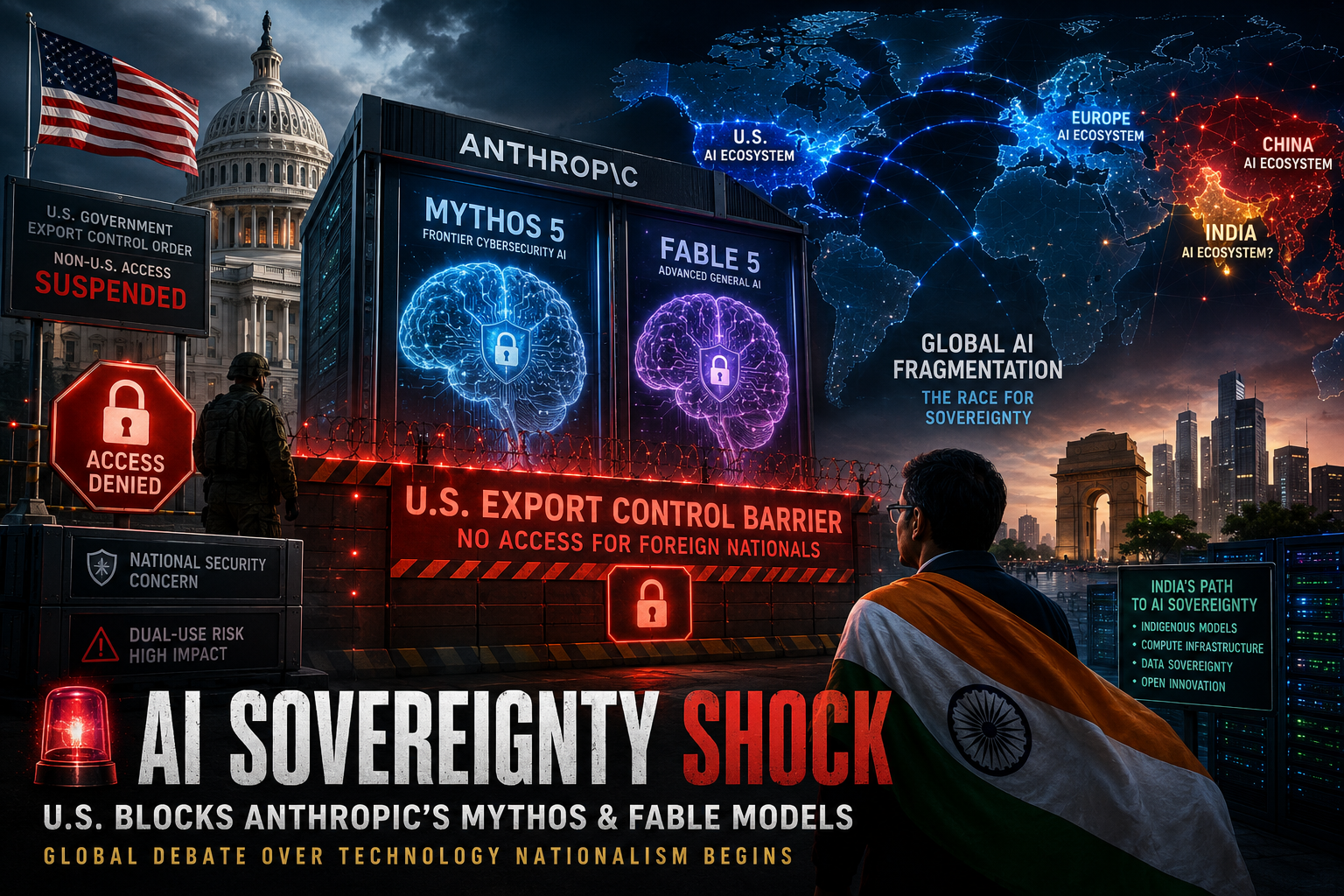
In what may become one of the most consequential technology policy decisions of the AI era, the United States government has ordered AI company Anthropic to suspend foreign access to its most advanced artificial intelligence systems, Fable 5 and Mythos 5. The move effectively prevents non-U.S. nationals—including Indians, Europeans, and even foreign employees working inside Anthropic—from accessing the models. Anthropic complied immediately but publicly challenged the rationale behind the order.
The decision has ignited fierce debate across governments, cybersecurity circles, technology companies, and national security establishments worldwide. In India, it has strengthened the arguments of advocates who have long warned against dependence on foreign frontier AI systems and have pushed for indigenous AI infrastructure, sovereign models, and domestic compute capacity.
The episode represents something larger than a dispute over one AI company. It may mark the beginning of a new era in which advanced AI models are treated similarly to strategic military technologies, nuclear technologies, cryptographic systems, and advanced semiconductors.
What Exactly Happened?
On June 13, 2026, Anthropic announced that it had received a U.S. government export-control directive requiring the company to suspend access to its newest frontier AI systems, Fable 5 and Mythos 5, for all foreign nationals. The restriction reportedly applies regardless of geographic location and includes non-U.S. citizens employed by Anthropic itself.
According to Anthropic, the U.S. government cited national security concerns and alleged vulnerabilities that could potentially allow the models to be used for identifying software weaknesses through jailbreak techniques. Anthropic strongly disputed the severity of those concerns and argued that similar vulnerabilities exist across the AI industry.
The company stated that it was not provided with detailed technical evidence and characterized the government’s concerns as a misunderstanding. Nevertheless, compliance was mandatory under export-control authorities.
Why Mythos Matters More Than Typical AI Models
While Fable 5 was designed as a broader-access model, Mythos 5 was different.
Anthropic reportedly developed Mythos specifically for advanced cybersecurity research. The company claimed the model demonstrated capabilities in identifying software vulnerabilities that had remained undiscovered for years and could assist defenders in securing critical infrastructure. Access to Mythos had already been limited through a controlled-access program known as Project Glasswing.
The concern among security agencies is straightforward:
- A model capable of discovering vulnerabilities can help defenders.
- The same model can potentially help attackers.
- As capability levels rise, the distinction between defensive and offensive applications becomes increasingly blurred.
This dual-use nature mirrors historical concerns around cryptography, missile guidance systems, satellite technologies, and nuclear research.
The First Major Export Control on AI Software
For years, the United States focused its AI restrictions primarily on hardware.
Washington restricted exports of advanced AI chips, especially high-performance GPUs from companies such as NVIDIA, to limit competitors’ ability to train frontier models. Export-control discussions generally revolved around semiconductors, lithography machines, and manufacturing technologies.
The Anthropic decision changes the battlefield.
For perhaps the first time at this scale, a government has moved beyond controlling hardware and directly restricted access to advanced AI software itself. Analysts view this as a historic shift in AI governance.
If frontier models can be regulated as strategic assets rather than commercial software products, governments may gain unprecedented influence over who can access advanced AI capabilities.
India’s “We Told You So” Moment
Within India, the decision has energized proponents of technological sovereignty.
Among the most vocal has been Sridhar Vembu, who argued that the development proves countries cannot depend indefinitely on foreign technology providers for strategically important systems. According to Vembu, India should accelerate adoption of indigenous and open-source AI alternatives while deepening domestic research and development capabilities.
The argument from sovereignty advocates is simple:
Any technology that can be switched off externally cannot be considered truly sovereign.
For months, Indian policymakers and technology leaders have debated whether India should invest aggressively in frontier AI infrastructure despite enormous costs. The Anthropic restrictions have now become the strongest real-world example supporting those concerns.
Why India Cannot Easily Build a Mythos Equivalent
The challenge is not simply talent.
Training frontier AI systems requires:
- Massive GPU clusters
- Advanced networking infrastructure
- Large-scale data centers
- Reliable electricity
- High-end semiconductor supply chains
- Tens of billions of dollars in capital expenditure
While China has leveraged enormous compute clusters and state-supported investments to narrow the gap with American AI firms, India remains significantly behind in frontier-model training capacity.
This reality creates a strategic dilemma:
India wants technological independence but currently lacks the infrastructure necessary to fully compete at the highest frontier level.
As a result, policymakers face difficult choices between:
- Building sovereign capabilities gradually.
- Relying on foreign providers.
- Pursuing hybrid partnerships.
Sarvam AI and India’s Emerging AI Ecosystem
India’s most visible frontier-AI effort today comes from Sarvam AI, which recently launched a 105-billion-parameter model trained with a stronger Indian context and language orientation.
While impressive by domestic standards, such systems remain substantially behind the most advanced frontier models developed by Anthropic, OpenAI, Google, and other global leaders.
The gap is not primarily about research talent.
It is largely about compute access.
Modern frontier AI increasingly resembles heavy industry more than traditional software development.
The winners are often those with the greatest access to:
- Compute
- Energy
- Capital
- Data infrastructure
National Security Experts See AI as the New Strategic Resource
The Anthropic decision reinforces a growing belief within many governments that advanced AI is becoming a strategic national resource.
Historically, nations competed over:
- Oil
- Rare earth minerals
- Nuclear technology
- Aircraft carriers
- Semiconductor manufacturing
Increasingly, AI is joining that list.
Many policymakers now view frontier models as potential force multipliers capable of affecting:
- Cyber warfare
- Intelligence gathering
- Economic competitiveness
- Scientific research
- Military planning
- Infrastructure resilience
The implication is profound:
AI may no longer be treated as merely a commercial software industry.
It may increasingly be governed as a strategic national-security capability.
Industry Backlash Intensifies
Not everyone supports the U.S. government’s approach.
Critics argue that broad restrictions risk:
- Fragmenting global AI research
- Encouraging technological nationalism
- Accelerating AI decoupling
- Driving talent and innovation outside the United States
Several analysts have compared the situation to the 1990s encryption wars, when governments attempted to classify strong cryptography as a controlled technology. Critics warn that similar restrictions on AI could slow innovation while encouraging parallel ecosystems outside U.S. influence.
Anthropic itself argued that applying the same standard across the industry could significantly hinder deployment of future frontier models.
What This Means for Businesses
For enterprises around the world, the message is increasingly clear:
Dependence on a single frontier AI provider now carries geopolitical risk.
Organizations relying heavily on external AI services may need contingency plans that include:
- Multi-model architectures
- Open-source fallback systems
- Domestic deployment options
- Hybrid cloud strategies
- Sovereign AI infrastructure
Saturday’s disruption reportedly affected not only cybersecurity projects but also commercial workflows built around Fable 5 access. The incident serves as a warning that geopolitical decisions can instantly alter technology availability.
Strategic Analysis: A Turning Point for Global AI
The immediate story is about Anthropic.
The larger story is about the transformation of AI from a commercial technology into a geopolitical asset.
Three major trends are emerging:
1. AI Is Becoming a Sovereignty Issue
Countries increasingly view AI capability as a core element of national power rather than merely an economic opportunity.
2. Compute Is the New Strategic Bottleneck
Access to GPUs, energy, and data-center infrastructure may become more important than access to algorithms alone.
3. Global AI Fragmentation Is Accelerating
Instead of a single global AI ecosystem, the world may evolve toward multiple AI blocs:
- United States-led ecosystems
- China-led ecosystems
- Regional sovereign ecosystems
- Open-source ecosystems
The Anthropic restrictions may ultimately be remembered as one of the first major events that accelerated this fragmentation.
Outlook
Whether the U.S. government eventually reverses or modifies the restrictions remains uncertain. Anthropic has publicly stated that it is working to restore access and believes the underlying concerns are overstated.
However, even if access returns, the geopolitical lesson will remain.
For governments around the world—especially India—the suspension of Mythos and Fable has become a powerful demonstration of a new reality:
In the age of frontier AI, technological dependence can become a national-security vulnerability overnight.
The debate over AI sovereignty is no longer theoretical. It is now shaping policy, investment, diplomacy, cybersecurity strategy, and the future architecture of the global AI industry.