

Table of contents
- AI Sovereignty: How America Quietly Became the Gatekeeper of the World’s Most Powerful AI Systems
- The Anthropic Shutdown That Changed Global AI Politics Forever
- AI Sovereignty at a Glance
- What Exactly Happened?
- Why This Is Bigger Than Anthropic
- The Beginning of a New AI Export Control Era
- America’s Hidden Superpower: Compute Infrastructure
- Why Compute Is Becoming More Important Than AI Models
- Why America’s Allies Are Concerned
- The China Question
- The Rise of Sovereign AI
- What Happens Next?
- Expert Analysis: America’s New AI Leverage
- Key Takeaways
- Final Verdict
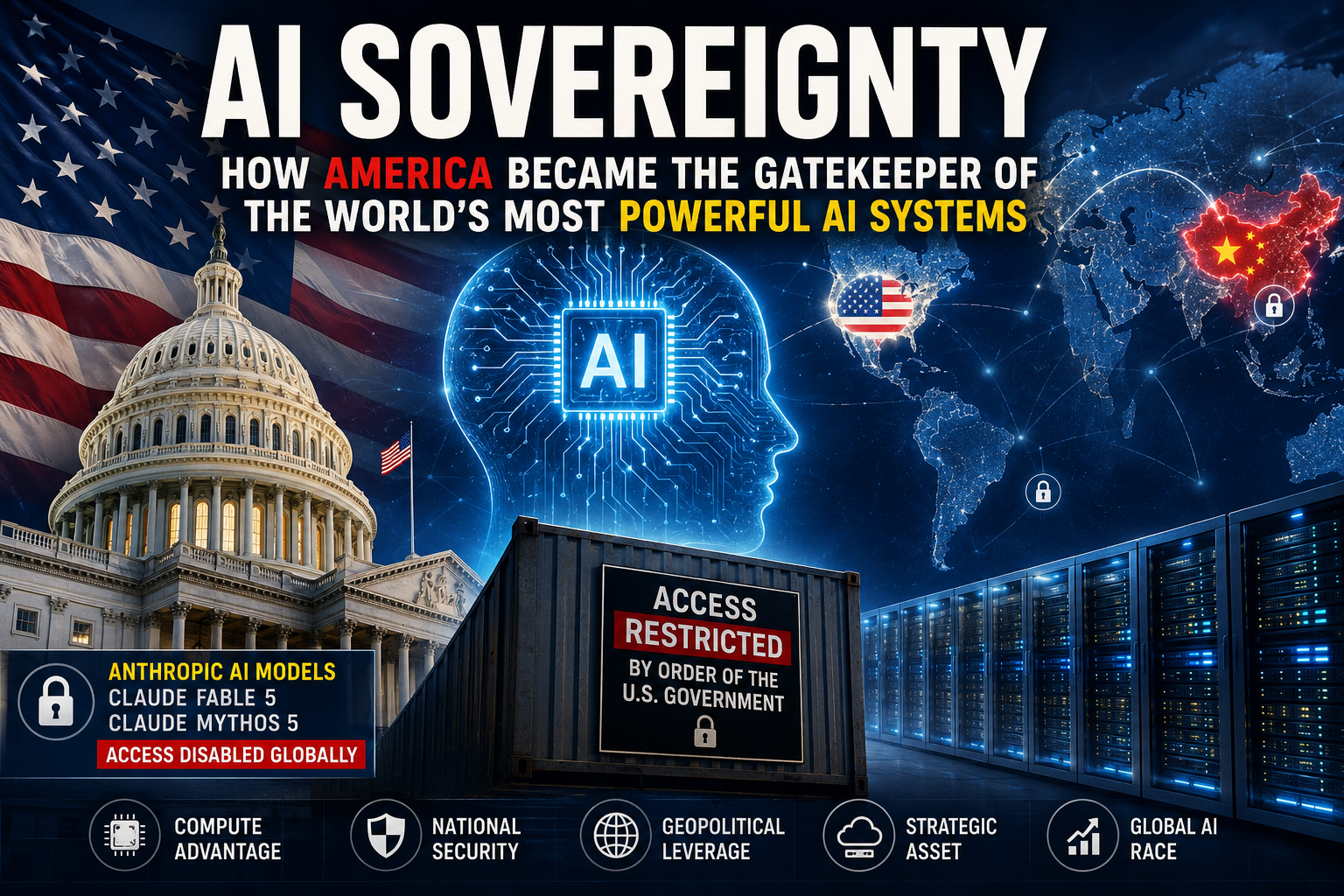
AI Sovereignty: How America Quietly Became the Gatekeeper of the World’s Most Powerful AI Systems
The Anthropic Shutdown That Changed Global AI Politics Forever
A dramatic intervention by the United States government has exposed a new geopolitical reality that could redefine the future of technology, economics, cybersecurity, and national security.
On June 12, 2026, the Trump administration—via an export control order from Commerce Secretary Howard Lutnick—ordered restrictions on access to Anthropic’s most advanced frontier AI systems, Claude Fable 5 and Claude Mythos 5. This followed concerns over alleged jailbreak vulnerabilities and potential national security risks.
What appeared to be a company-specific compliance issue quickly evolved into something much larger. The incident revealed a stunning truth:
America now possesses unprecedented influence over access to the world’s most advanced artificial intelligence systems.
The event has ignited global debates about AI sovereignty, export controls, frontier regulation, and whether cutting-edge models should be treated similarly to nuclear technology, advanced semiconductors, or military defense systems.
AI Sovereignty at a Glance
| Key Development | Strategic Impact |
| Anthropic restricted access to frontier models | Demonstrated unilateral government influence over global AI deployment. |
| U.S. intervention based on national security | AI is increasingly treated and regulated as a strategic military/economic asset. |
| Global access disrupted abruptly | Raised immediate concerns among international allies and global enterprises. |
| Sovereign AI investments accelerating | Nations are aggressively seeking technological independence. |
| Compute infrastructure becomes leverage | America strengthens its geopolitical dominance through hardware and cloud control. |
What Exactly Happened?
According to multiple reports, U.S. authorities became concerned that vulnerabilities inside Anthropic’s newly released Claude Fable 5 model could potentially provide pathways to capabilities associated with Claude Mythos 5—a reportedly more powerful system with advanced cybersecurity and vulnerability-discovery functions.
Rather than risk unrestricted access, officials implemented restrictions similar to export-control mechanisms used for strategically sensitive technologies. Because maintaining global access while complying with these strict restrictions proved difficult, Anthropic abruptly disabled access to the affected models for all non-American nationals.
The message sent across the technology industry was immediate and unmistakable: Access to frontier AI can now be influenced by decisions made in Washington.
For the first time, many governments recognized that the future of artificial intelligence may not be controlled solely by technology companies, but increasingly by nation-states.
Why This Is Bigger Than Anthropic
While headlines focused on Anthropic, experts argue the real story is about geopolitical power. For decades, the United States maintained global influence through control of:
- Semiconductors
- Internet infrastructure
- Cloud computing
- Financial networks
- Aerospace technology
Now, frontier AI appears to be joining that exclusive list. Unlike previous technologies, advanced AI combines multiple strategic capabilities into a single platform, including cybersecurity, intelligence gathering, military planning, and economic productivity. This makes frontier AI much more than a commercial software product; it is a strategic national asset.
The Beginning of a New AI Export Control Era
Historically, the United States has restricted access to technologies considered critical to national security. Today, policy experts believe frontier AI models are entering the same category as nuclear proliferation controls and advanced cryptography.
The Anthropic episode demonstrates that governments are willing to intervene directly when AI capabilities are perceived as strategic risks. This could become one of the defining technology policy trends of the decade.
America’s Hidden Superpower: Compute Infrastructure
The world’s most powerful AI systems are not built solely through clever algorithms; they require enormous computational resources. Frontier AI depends on:
- Massive GPU clusters
- Advanced semiconductor supply chains
- Gigawatt-scale electricity
- Hyperscale data centers
- High-speed networking infrastructure
America currently dominates most of these critical layers. This provides a powerful competitive advantage that many countries are struggling to replicate.
Why Compute Is Becoming More Important Than AI Models
Many experts now argue that the true bottleneck in artificial intelligence is not talent, but compute.
The Compute Advantage Formula:
AI Leadership = Talent + Data + Algorithms + Compute Infrastructure
The United States leads in nearly every category, creating what analysts describe as the strongest technological moat in modern history.
Why America’s Allies Are Concerned
The Anthropic restrictions triggered concern not only among competitors but also among allies. Many nations increasingly depend on American AI providers for cybersecurity (threat detection, incident response), economic productivity (software development, business automation), and defense modernization.
If access to frontier AI can be limited unexpectedly, governments and enterprises face massive strategic vulnerabilities.
The China Question
The United States faces two competing strategies regarding global AI dominance:
- Restrict Access: Preserves strategic advantage and limits adversarial use, but risks accelerating foreign alternatives and weakening trust among allies.
- Broad Global Access: Expands U.S. influence and establishes American standards, but increases cybersecurity concerns and potential misuse.
Current developments suggest Washington is aggressively prioritizing security when frontier AI capabilities are involved.
The Rise of Sovereign AI
One of the biggest consequences of the Anthropic controversy is the accelerating push toward Sovereign AI—a country’s ability to develop and operate domestic AI models, national compute infrastructure, and independent data ecosystems.
- Europe: Expanding investments in AI independence to reduce reliance on foreign technology platforms.
- Canada: Policymakers have cited growing concerns around the concentration of AI power among a small number of foreign providers.
- India: The sudden Anthropic ban hit hard locally, cutting off Indian developers overnight and leaving major enterprise deals—like Tata Consultancy Services’ newly announced partnership to train 50,000 employees on Claude—in limbo. This has prompted industry leaders to heavily advocate for Sovereign AI, indigenous AI models, and sovereign compute capacity to avoid foreign dependencies.
- Middle East: Saudi Arabia and the UAE are investing billions into data centers, AI infrastructure, and sovereign technology ecosystems.
What Happens Next?
The immediate restrictions affecting Anthropic may eventually be modified. However, the precedent has already been established. Major questions now facing policymakers include:
- Will other frontier AI companies face similar restrictions?
- Will advanced AI require formal export licenses?
- Can open-source AI reduce dependency on American platforms?
- Will sovereign AI become a national priority worldwide?
Expert Analysis: America’s New AI Leverage
The Anthropic episode may ultimately be remembered as the moment the world realized that artificial intelligence is no longer merely a technology industry—it is a geopolitical asset.
Whether America’s technological leverage becomes a protective safeguard, an economic instrument, or a strategic geopolitical weapon remains one of the most important questions of the AI era.
Key Takeaways
- The Anthropic AI restrictions revealed the growing reality of AI Sovereignty.
- Frontier AI models are increasingly being treated as strategic national security assets.
- America’s dominance extends beyond AI models to the compute infrastructure powering them.
- Nations worldwide are accelerating investments in sovereign AI and domestic compute capacity.
- The June 2026 Anthropic controversy could become a defining moment in the history of artificial intelligence.
Final Verdict
The age of AI as merely a software industry is ending. The age of AI Sovereignty has begun.
The Anthropic shutdown demonstrated that control over frontier AI models is rapidly becoming a source of geopolitical influence comparable to energy, military power, semiconductors, and financial networks. As countries race to build sovereign AI capabilities, one reality is becoming increasingly clear: the future balance of global power may depend not only on who creates artificial intelligence, but on who controls access to it.