

Table of contents
- 🚨 Indian IT Stocks Witness Massive Selloff After Accenture’s Warning
- 📉 Market Wealth Destruction: ₹2 Lakh Crore Vanishes
- 🔍 What Exactly Did Accenture Say?
- 🤖 AI Is Growing — But Not Generating New Spending Yet
- ⚠️ The Bigger Red Flag: Outsourcing Demand Is Weak
- 🌍 Global Technology Stocks Also Come Under Pressure
- 🏦 What Brokerages Are Saying
- 📊 Why Dalal Street Is Nervous
- 🔮 What Happens Next for Indian IT?
- 💡 Investor Takeaway
🚨 Indian IT Stocks Witness Massive Selloff After Accenture’s Warning
Indian equity markets suffered a sharp shock on Friday as global technology consulting giant Accenture delivered a cautious outlook that triggered a broad-based selloff across India’s information technology sector.
The result was brutal.
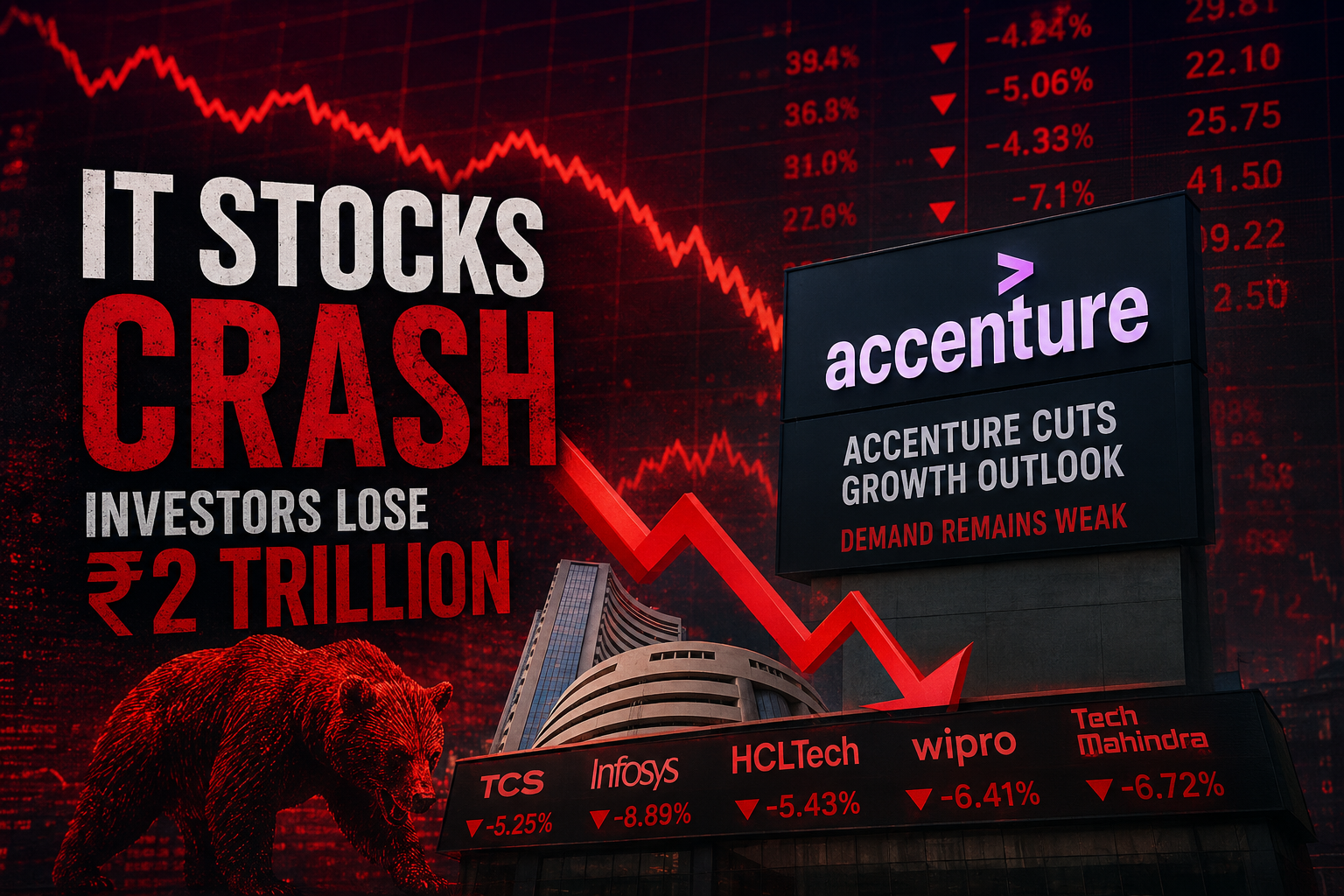
Within minutes of market opening, investors lost nearly ₹2 lakh crore (₹2 trillion) in market capitalization as technology stocks collapsed across the board. Heavyweights including Tata Consultancy Services, Infosys, HCLTech, Wipro, and Tech Mahindra plunged between 3% and 8% as investors rushed to exit the sector. (Reuters)
The selloff pushed the Nifty IT index down nearly 6%, making it one of the worst-performing sectors of the day. Market participants interpreted Accenture’s latest earnings commentary as a warning sign that global technology spending remains weak despite the rapid growth of artificial intelligence. (Reuters)
📉 Market Wealth Destruction: ₹2 Lakh Crore Vanishes
The impact was immediate and widespread.
According to market data, the combined valuation of major listed companies dropped by roughly ₹2 lakh crore during early trading hours as investors aggressively sold technology shares.
Major Losers
| Company | Intraday Decline |
|---|---|
| TCS | 5%–8% |
| Infosys | Up to 9% |
| HCLTech | 5%–8% |
| Tech Mahindra | 5%–8% |
| Wipro | 3%–7% |
| Coforge | Sharp decline |
| KPIT Technologies | Sharp decline |
| Tata Elxsi | Sharp decline |
| Sonata Software | Sharp decline |
Infosys alone reportedly lost around ₹40,000 crore in market value after its stock crashed nearly 9% and hit a fresh 52-week low. (The Economic Times)
🔍 What Exactly Did Accenture Say?
Ironically, Accenture’s quarterly results were not terrible.
The company reported approximately $18.7 billion in third-quarter revenue, representing around 6% year-over-year growth. Earnings per share also exceeded analyst expectations. (Investing.com)
However, investors focused on the future rather than the past.
The Key Negative Signals
✅ Revenue guidance reduced
✅ New bookings weakened
✅ Outsourcing demand slowed
✅ Clients remain cautious on spending
✅ AI spending is replacing existing budgets rather than creating new budgets
Most importantly, Accenture lowered the upper end of its FY2026 revenue growth forecast from 3–5% to 3–4%. (The Economic Times)
That seemingly small revision sent a powerful message:
Global enterprises are still hesitant to increase technology spending.
🤖 AI Is Growing — But Not Generating New Spending Yet
One of the biggest themes investors were hoping for in 2026 was an AI-driven technology spending boom.
Instead, Accenture’s management suggested something very different.
Companies are showing strong interest in artificial intelligence projects, but many are funding those initiatives by reallocating existing technology budgets rather than increasing total spending. (Investing.com)
This distinction is critical.
For Indian IT companies, growth traditionally depends on expanding technology budgets and large outsourcing contracts.
If AI merely shifts money from one project to another, overall revenue growth could remain sluggish.
⚠️ The Bigger Red Flag: Outsourcing Demand Is Weak
For India’s software export industry, perhaps the most concerning data point was the weakness in outsourcing bookings.
Accenture reported softer booking trends, reinforcing concerns that global clients remain cautious about signing large long-term contracts. (Fortune India)
That matters because outsourcing remains the backbone of India’s $315 billion IT services industry. (Reuters)
When enterprises delay digital transformation programs or discretionary technology projects, Indian firms often experience slower deal wins and weaker revenue growth.
🌍 Global Technology Stocks Also Come Under Pressure
The panic wasn’t limited to Dalal Street.
Accenture shares plunged roughly 15–18% in U.S. trading after the earnings announcement. The selloff spread across global technology service providers. (Reuters)
Global Reaction
| Company | Share Price Impact |
|---|---|
| Accenture | -15% to -18% |
| Infosys ADR | Up to -10% |
| Wipro ADR | More than -7% |
| Cognizant | More than -10% |
| IBM | Around -5% |
| Capgemini | Nearly -9% |
The widespread decline suggests investors fear a prolonged slowdown in enterprise technology spending worldwide. (Reuters)
🏦 What Brokerages Are Saying
Several major brokerages turned more cautious on the IT sector after Accenture’s earnings.
Key Concerns Raised by Analysts
1. Growth Recovery May Take Longer
Analysts believe hopes for a near-term recovery in IT demand have weakened considerably after Accenture’s guidance cut. (Reuters)
2. Earnings Downgrades Could Follow
Some brokerages warned that Indian IT firms may face earnings estimate cuts if demand remains weak through FY27. (Reuters)
3. Valuation Pressure Remains
Despite the sharp correction already witnessed in IT stocks, analysts argue that valuations may still face pressure if revenue growth continues slowing. (Reuters)
📊 Why Dalal Street Is Nervous
Investors view Accenture as one of the best indicators of global enterprise technology demand.
Because Accenture works with many of the same multinational clients served by Indian IT giants, its commentary often provides an early glimpse into future spending trends.
When Accenture reports weak demand, markets typically assume Indian firms could face similar challenges in the coming quarters. (Reuters)
🔮 What Happens Next for Indian IT?
The near-term outlook remains challenging.
Several headwinds continue to weigh on the sector:
- Weak discretionary spending
- Delayed technology projects
- Geopolitical uncertainty
- Budget reallocations toward AI
- Slower outsourcing contract wins
- Pressure on traditional labor-intensive IT services models from AI automation (Reuters)
However, not everything is negative.
Accenture’s management emphasized that demand for AI transformation projects remains strong and continues to grow faster than its overall business. The company is also expanding aggressively through acquisitions in AI, cloud computing, cybersecurity, and data services. (Investors)
💡 Investor Takeaway
Friday’s IT sector crash highlights a growing reality that investors can no longer ignore:
The AI revolution is real, but its financial benefits are taking longer to materialize than markets expected.
For now, global clients remain cautious, outsourcing demand remains under pressure, and technology budgets are not expanding meaningfully.
Until enterprise spending rebounds, Indian IT companies may continue facing volatility, earnings pressure, and valuation challenges.
The long-term AI opportunity remains intact—but investors are discovering that patience may be required before that promise translates into substantial revenue growth. 📉📈